A week back in Oxford

Dec 8, 2025
9 min read
Updated: Dec 11, 2025

Photo credit: Fisher Studios
This year I started the Global Health Leadership Programme, a two-year hybrid master’s at Oxford with 23 participants from different health systems around the world. Module 1 in September and October included matriculation and a brief introduction to Oxford life before we all returned to our work back home. Coming back for Module 2 felt like stepping again into that shared sense of momentum, learning from both the teaching and from one another.
Sunday, November 30
Oxford, England
I flew into Heathrow this morning and went straight to Oxford. Earlier this month I submitted my first assessment and worked through the pre-readings for Module 2, which focuses on organisational leadership. After dropping my suitcases at Saïd Business School, I walked around the city to get my bearings again. I wandered through the Covered Market, the Christmas stalls, then stopped by St. Aldate’s for the afternoon service. The Christmas lights around the city made the afternoon more welcoming.
In the evening, several of us met for Persian dinner. A few people had arrived earlier in the week for other events, including the triennial Winter Ball at Merton College. Our WhatsApp group had been active with updates these past few weeks, so meeting in person felt like a natural continuation of the conversations we had been having. By the end of the evening, it felt easier to shift back into the student rhythm and focus on the week ahead.
Monday, December 01
I was still adjusting to the jet lag and to the damp indoor cold of an English winter. It felt very different from the dry Arctic cold I had experienced earlier this month, and it made everything feel slower.
In the afternoon we met at the Thatcher Business Education Centre for our first optional enrichment session. A few more classmates arrived from their home countries, bringing the group close to full attendance. We discussed our recent assessment, including the challenges of writing a reflective piece, which was new to many of us. It was the first time I had looked closely at the writing process. Something that appears simple often has many implicit steps. I realised that my academic writing approach comes from my undergraduate political science courses and from high school English. At one point someone mentioned how difficult it can be to stay within a word limit, which reminded me of a colleague at work who once said that French text often takes up more space than English because of differences in structure and phrasing.

Afterwards, we were given space to contribute from our own backgrounds as part of learning from one another. One of our classmates presented on private equity. This module a few volunteers also shared snacks from their home countries, a tradition we hope to continue in the next modules. Hashem from Saudi Arabia started first with a wide variety of dates: some stuffed with cashews, others covered in cocoa powder, sesame, or coconut, rosewater and cappuccino-flavoured date biscuits, with tahini for dipping, and saffron coffee to go with it. Then, a few of us went out to a tapas restaurant before heading back for the night.
Tuesday, December 02
In the morning, I tried a seasonal beetroot chai latte at the Clubhouse in Saïd before heading to the lecture hall for our first official day of Module 2. The theme of the day was how leaders navigate organisational complexity.
The morning session was on organisational governance. The speaker walked us through how large institutions make decisions when multiple agendas and histories overlap. Using Christchurch and the Jesuits as examples, he showed that governance isn’t mainly about control. Instead, it is about creating structures and routines that make people talk and balance competing priorities over time.
Lunch upstairs was very good, as usual. The food was laid out on the long black countertop with small white labels for each dish. There were many options, but I focused and chose the tomato lentil soup with herb naan.

In the afternoon, we had two sessions: paradoxical leadership and leadership for healthcare complexity. Both focused on why large systems carry tensions that don’t resolve cleanly and why leaders need to work inside that ambiguity. The class turned the case study exercise into a short role play. It was entertaining but also based on real situations my colleagues had experienced. Between sessions, Bahaa shared a large selection of Egyptian dates, and Mike brought around chicken jerky from Singapore.
We changed into our Christmas jumpers for a small cocktail reception. Then we had one more talk from the Dubai Health representative. She described the development of their system and the main structural decisions they had made. It also happened to be UAE National Day, which made the presentation more fitting.


Afterwards, I went with Erin and Bell to Somerville College for Michaelmas Dinner, the formal end-of-term dinner. At first, my name wasn’t on the registration list. One staff member told me to wait because they weren’t sure if there would be an extra seat after everyone else had gone in. I went to the end of the line and tried again. After a second check, it turned out I was assigned to the high table and was directed to a reception downstairs.
Dinner was three courses. I had a mushroom pâté with sourdough and watercress, a pumpkin and Stilton tart with potatoes and Brussels sprouts, and a traditional Christmas pudding. After that, they served mince pies and Somerville chocolates. The high table group also had a short cheese reception.
Somerville is one of Oxford’s historic colleges and was originally a women’s college. The choir wasn’t performing tonight, so we sang Christmas carols instead. My table mates encouraged me, and after asking the Principal, I led O Come All Ye Faithful and O Little Town of Bethlehem. It was a fun way to end the day.
Wednesday, December 03
Today centred on what makes organisations adaptable and resilient. In the morning, we focused on organisational design. Our exercise paired us as co-CEOs of a fictional tech company, each given different instructions on how the organisation should be structured. It was based loosely on Google’s early experiments with managerless teams and led into a broader discussion on how hierarchy and structure shape how people work. Organisations are always shifting between being flatter or more traditional, and the conversation eventually moved to Buurtzorg, a completely flat care model that operates very differently from most health systems.

As the session wrapped up, Hashem presented a piece of handmade Arabic calligraphy, written in the Diwani script, to Dr Kamal Mahtani, who directs the Oxford Primary Care Research Leadership Programme. It was a thoughtful and generous gift.
Lunch was a traditional roast with Yorkshire pudding, carrots, parsnips, sautéed cabbage, and roast potatoes.
The afternoon moved into organisational resilience and how organisations function under VUCA (volatility, uncertainty, complexity, ambiguity). Each of the groups chose a mega trend and reflected on how resilience had shown up or not in our contexts. Dubai Health closed the academic day with a case study on how they approach system redesign and innovation in their region.
In between sessions, our colleagues from Jordan, Austria, and Switzerland set out baklava, Mozartkugel, Viennese wafers, and Aachener Printen. It was an unexpected but very appreciated mid-day pick-me-up.
After class, a few of us walked to the Christmas market. It was lively, with lights everywhere. The open mic was running, and my colleagues waited with me until the host wrapped up his set. I started with two contemporary pieces before moving to Once in Royal David’s City. I noticed people listening from the balcony above and from the front, some filming and others just enjoying the moment. I ended my set of five songs with My Heart Will Go On. It was fun to perform, even though the cold made it hard to feel my hands on the mic.
On the way back we stopped at a friendly kebab stand. After being outside in the cold for nearly three hours, having this hot meal was welcome. We brought the food back to Sami’s residence at St Cross and ate there.
Thursday, December 04
The morning opened with a session on how leaders prepare organisations for the future. The focus was on scenario thinking and on the value of examining wider forces rather than relying on a single expected path. Scenarios are not forecasts. They help reveal assumptions that guide present decisions, often without our awareness.
We began by identifying the assumptions we held about the future. Once these were named, we created three scenarios built on different combinations of those assumptions. The process made visible the limits of our usual thinking. Each scenario shifted the context in a distinct way, and returning to the assumptions at the end helped us see where our original views remained stable and where they changed.
In the afternoon, we moved into the strategy session. The emphasis was on execution and on the organisational habits that determine whether a plan becomes real. Many strategies fail not because the idea is weak but because the organisation cannot deliver it. Priorities may become scattered, or teams may lose alignment. Culture can also redirect efforts in subtle ways and slow the pace of change even when intentions are clear. A strategy has value only when it can be carried out in practice. The morning scenarios linked naturally with this idea, because they challenged us to think about what leaders must hold firm as conditions shift.
Photo credit: Fisher Studios
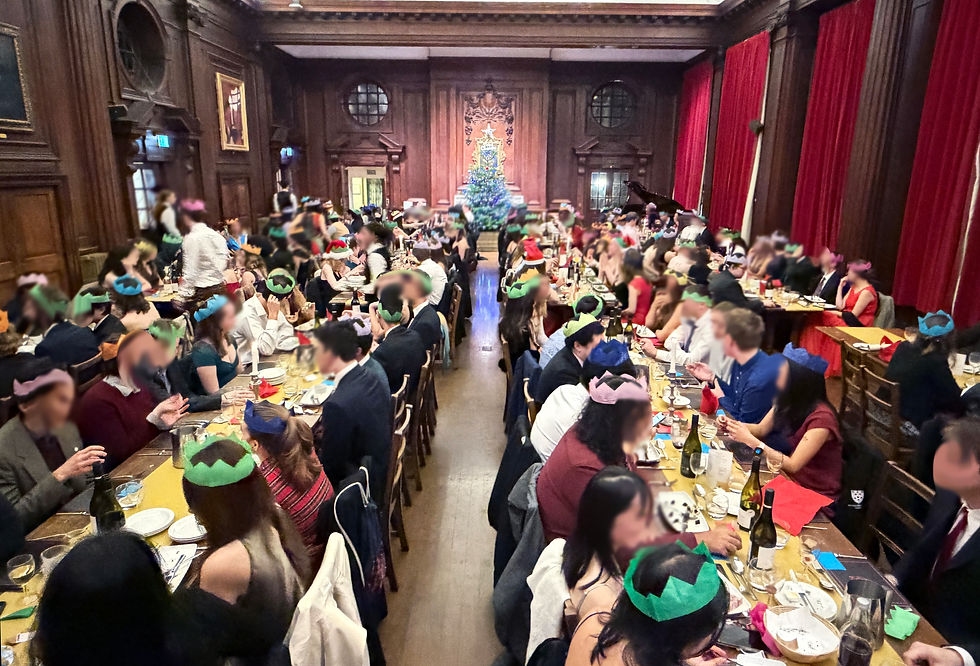
In the evening, we dressed in black tie for the formal dinner at Lady Margaret Hall with the Diploma in Artificial Intelligence programme. Oxford formal dinners carry a long tradition of bringing students and faculty together in a shared setting that encourages reflection and conversation.
The dining hall was lit with warm lights, and Christmas trees stood among the portraits on the walls. Long tables were set a beautiful and festive arrangement. At each place setting there was a small paper firecracker, which we opened to reveal paper crowns and some conversation starter cards.
My starter was sea salt roasted beetroot with crispy carrot and whipped feta, served with garlic bruschetta and a small salad. The main course was a butternut squash Wellington with vine tomatoes and mousseline potatoes. Dessert was chocolate mousse and poached pear. Mince pies followed, along with small chocolate coins. When the dinner concluded, the bus returned to take us to our next stop, whether back to Saïd or onward into the night.
Friday, December 05

Today was our last day of Module 2 and the feeling of the week coming to an end was noticeable. After several days together and the formal dinner the night before, we had a sense of familiarity and collegiality.
The first session on ethics and AI was philosophical, with no slides or recording. The opening argument was that AI may be new, but the ethical questions are familiar. The speaker also mentioned that harm often comes from ordinary people following systems without questioning them, and AI can magnify this if we are not careful. AI often lacks context and can present confident answers that are wrong. At the same time, she reminded us that individuals have more influence than they think, and can push for safer design, stronger privacy, and better judgement when using AI.
The second session looked at developing clinical leaders. The pre-reading was an article on healthcare complexity from 2001, yet many of the ideas still felt familiar. Our discussion moved to what qualities modern leaders need. Competency is about knowing how to do specific tasks. Capability is the ability to stay steady when things shift, to read what is happening, and to adjust when the plan no longer fits. She noted that most real leadership work happens in that space, because healthcare changes quickly and rarely follow a neat sequence. We also did an exercise imagining what leadership training could look like if money and time were not a limit. After hearing all our ideas, she reminded us that leadership is not something you learn from more sessions. You learn it by trying it yourself, with support.
The standouts for lunch were the cream of mushroom soup and the steak and fries with roasted mushroom and aubergine and buttery gravy. The servers explained that almost everything at Saïd is homemade. Throughout the week in the clubhouse there had been fresh cakes, rotating drinks like hot chocolate, beetroot chai, turmeric lattes, and flavoured waters. The staff were always friendly and seemed proud of their high-quality work.
Right after, we had a gift exchange. I brought tawâw, an Indigenous Canadian cookbook that I like for its connection to food and story. I received a book on Oxford architecture in return. Others brought Egyptian artefacts, a carved box, a jewellery holder, and other thoughtful gifts from their regions.

The final session was a Q and A with three representatives from Dubai Health, which pulled together the concepts from our organisational leadership module. I opened by asking whether their transformation had started with a clean slate and how they approached cultural integration. They explained that it was not a greenfield project at all, but a brownfield one. The process of bringing together groups with different identities and histories required much ongoing engagement.
The questions that followed touched on governance, partnerships, system design, workforce development, and how they think about AI literacy in a changing health system. However, two points stayed with me. The first was “Do not think of yourself as a leader, think of yourself as a servant.” The other was “cherry picking” from many places and adapting what fits to their own context.
After a short briefing about our next assessment and a preview of the upcoming module, people began saying their goodbyes. Some were heading to London for flights while others were staying in Oxford a little longer. I tried to attend the carol service at Keble College, but it was raining heavily and I was carrying several bags. After circling without finding the main entrance, I turned back and called it a night.
Saturday, December 06


Comments