Mistissini

Apr 27
8 min read
Monday, April 20, 2026
Montréal → Chibougamau → Mistissini

I started the morning in an Uber to the airport.
« Quel vol ? »
« Air Creebec. »
« Air Québec ? À l’aéroport Trudeau ? »
« Non… le terminal Air Creebec. C’est comme un aéroport privé. »
« Ah. Vous allez où ? »
« Mistissini. »
« États-Unis ? »
« …Non, une petite communauté au nord. »
He looked just as confused as he dropped me off.
From there, I continued with the now-familiar flight routine. We landed in Chibougamau and most people got off. I stayed on, assuming it was just a stopover.
The pilot recognized me from last July and said hello.
“Where are you going?”
“Mistissini.”
“Ah, the small plane.”
I nodded like I knew what he meant. Then someone from the front turned around.
“No, you get off here. You take a taxi, about an hour to Mistissini.”
“What?”
I vaguely remembered Valérie Élément and David Delva mentioning this during our debrief after the Chisasibi trip, but I hadn’t really registered it.
I got off the plane and into the terminal. Where am I exactly?
At the counter, the agent told me there had been a car, but it had already left. She showed me a number to call. When I did, I was told it was for emergency evacuation transport. I tried another number. Nothing.
I went on Teams and called David. He immediately reached out to Marina, one of the nurses in Mistissini, and they tried to sort things out from their end. The suggestion was to take a taxi.
I looked around. What taxi?
Then David asked, “Do you have cash?”
I checked my wallet. About $50. “That’s not enough, right?”
He paused. “Let me figure something out.”
A few minutes later: “Are you ready? It’s $280 one way. Cash. Ask the driver to stop at an ATM. Take out enough for the aller-retour. Don’t worry, it’s reimbursable.”

The drive to Mistissini was about an hour and twenty minutes, down a road surrounded by boreal trees. At the entrance to the community, there was a barricade across the road. The driver rolled down the window and said, “Mistissini. Clinic. Doctor.” and we were waved through.
I asked him why the barrier was there.
I remembered hearing about it. « Mais c’était il y a deux mois, non ? »
He didn't say anything more.
He dropped me off at the transit. I messaged David and the nurses to let them know I’d arrived. Soon after, I met the nurses, Isabelle and Marina, for the first time in person. They had facilitated my past two telehealth clinics. After a brief tour, I set up my temporary office. I was there for the week to do allergy clinic.
The afternoon involved multiple food allergies, a drug challenge, and intradermal drug testing. The nurses were very on top of things and kept everything moving.
One of the physicians mentioned they had been planning to send a consult to Montréal. She didn’t think the drug allergy was high risk but didn’t want to take the chance.
I told them, “I’m here.”
Later in the evening, I was invited to play pickleball. I hadn’t brought the right shoes and wasn’t expecting that, so I passed. Marina drove me back to the transit instead. It had been a long day.
Wednesday, April 22, 2026
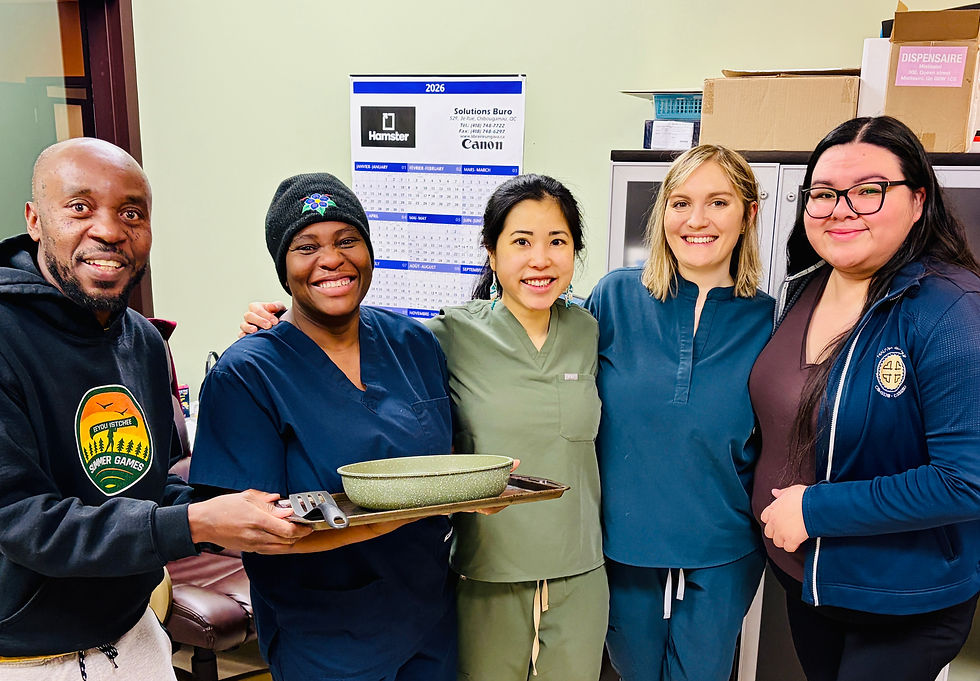
I was going through the list when I suddenly heard everyone singing “happy birthday.” People had gathered in the nursing station to celebrate Isabelle’s birthday. Marina had a freshly baked almond flour apple cake, still warm, with vanilla ice cream.
Between that, and all the talk of free sports activities that were available each night, it struck me how much was happening here. It felt busy, active, and alive in a way I hadn’t anticipated.
I went to see my first patient and the morning went fast. Food challenges, drug challenges, one patient after another. Suddenly, it was lunchtime.
I went looking for water, since there was a boil water advisory in town, and ended up chatting with a couple of the health workers instead. We talked about where they were from, where they had been. A lot of people working up north had ended up there because they were looking for something a bit different, with a mix of adventure, working across cultures, and being part of a team.
Partway through, someone asked, “Did you eat lunch?”
I hadn’t. I went back, ate quickly, and kept going.
The afternoon brought more patients, including some who had driven in from Waswanipi and Oujé-Bougoumou. In between visits, I began to learn more about the community.
One father mentioned about creating structured spaces for men. We talked about what that might look like, and what men could offer through community service, woodworking, and other hands-on ways of contributing.
The conversation shifted toward food, and then toward land. Back then, he explained, people relied on what was available. Meat, berries, gathered plants. Things were boiled, dried, or smoked. People were constantly moving, hunting, and gathering from the land. Now, everything has changed. Store-bought food is expensive. Fresh food is even more expensive. And when traditional food is available, the way it is prepared has changed too.
I remembered a comment from the day before. “Sometimes a bannock isn’t that different from a donut.”
I asked if people could grow their own food.
“Not easily,” he said, referring to the land and the climate.
But greenhouses could work. They had tried it before. It takes investment, planning, and working within local structures, but in the long run, it could make a difference, not just for food but for the community. It would give people something to build, maintain, and share.
He mentioned small efforts already happening, like gardens in the summer, people growing what they can, even flowers. The conversation circled back to the earlier idea of creating spaces where people could contribute and feel useful in a changing environment. It was not about going back to the past but rather finding ways to carry parts of the culture into a modern context.
The clinic day stretched longer than expected. A few add-ons kept me there into the evening.
Partway through, Suzanne Matoush messaged me and invited me to church.
“What time does it start?” I asked.
“Seven.”
“And ends when?”
“Ten.”
“Every day?”
“Yes.”
Someone mentioned there were four churches in town. It made more sense now but still felt surprising.
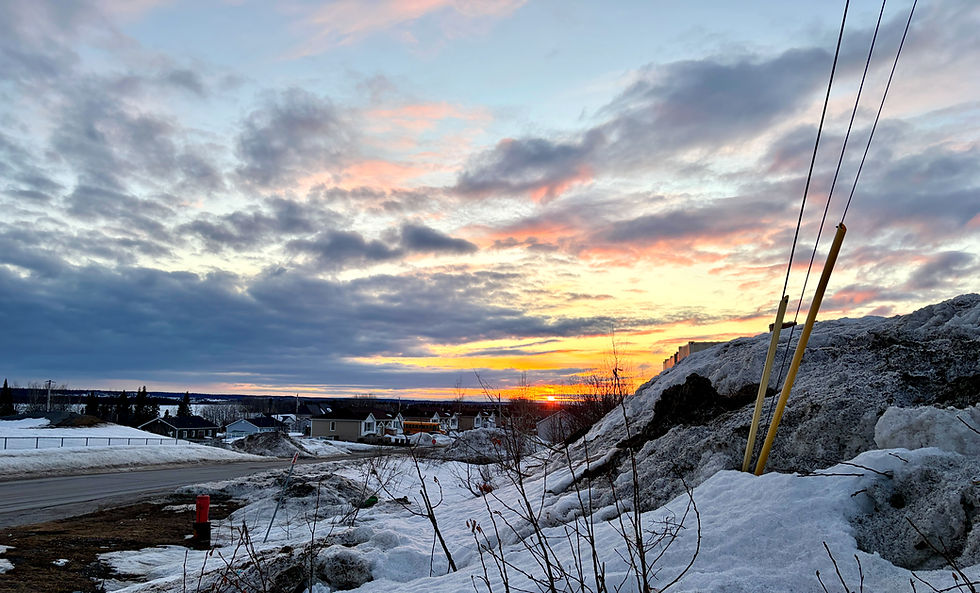
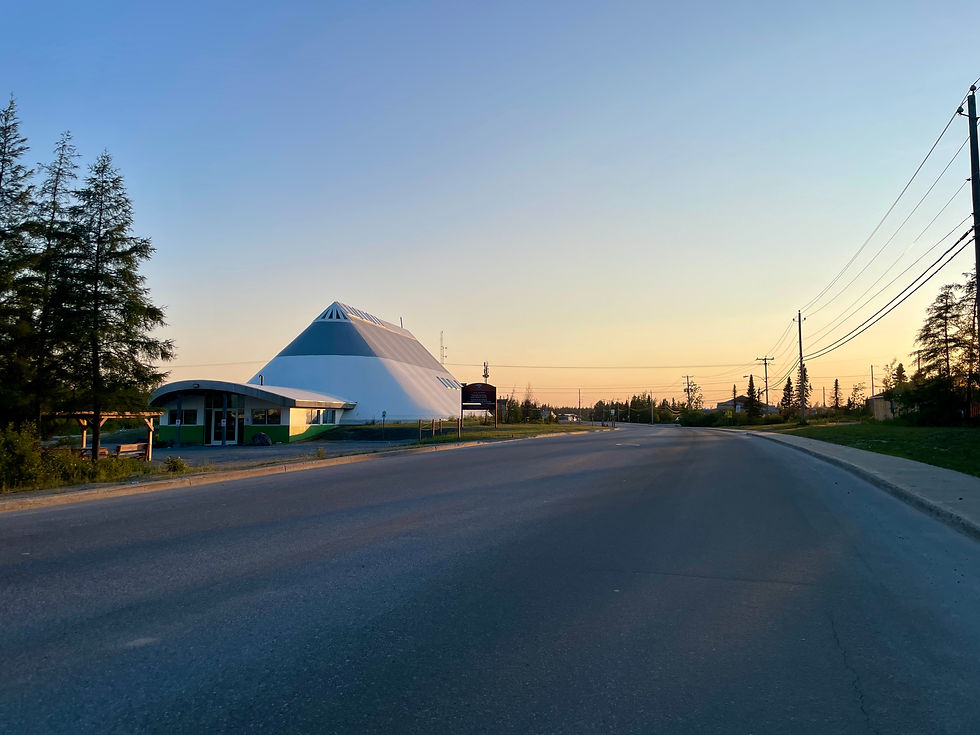
By the time I left the clinic, it was nearly 8pm. Outside, the light stretched across the road, the sky turning pink and orange over the melting snow. I walked back to the transit, made dinner, and ended the day.
Friday, April 24, 2026
My last day at the clinic was supposed to be light. We had planned for a morning list, with the afternoon left open for any add-ons. But as the day went on, more patients kept appearing. Some had been scheduled for follow-up and had all come in that day. One family had left home early for a two-hour drive for a follow-up booked on short notice. Names were added one by one.
It turned into a full clinic. Drug challenges, food challenges, and complex cases. By midday, we had worked through lunch without really noticing. I asked Isabelle if I should start the next drug challenge so she could take her lunch. She said she was already there and would take it.
The receptionist brought in moose meat. I had asked about traditional food earlier, and she said she would bring some. I asked where it came from.
“Oh, someone hunted it,” she said. “It’s shared in the community.”
A few minutes later, her husband walked in.
“I hunted it last night,” he said, joking.
I asked how it was prepared.
“However you want,” she said.
She mentioned once bringing moose meat to Gatineau to share with a family her child met at camp. They tried it stir-fried with gravy and loved it.
The other receptionist came back with lunch. I could smell potatoes.
“What’s that?” I asked.
“Poutine.”
“Where did you get that?”
There was no cafeteria. He showed me a Facebook page where people posted meals for sale. Some were delivered, some picked up, usually paid in cash or by e-transfer. The day before, someone had sold plates of moose stew that had been cooking all day.
“It was really soft, really tender,” he said.
In the afternoon, we debriefed. Some of it was straightforward. Other parts were less clear. We discussed about how to start subcutaneous immunotherapy in the region. There were many unknowns and steps that would need to be worked out, both within and outside the territory. Even in Montréal, things don’t always run smoothly.
“I know the medicine,” I said. “The logistics, we’ll have to work through.”
Around 4:30 p.m., Marina said she had to leave.
“I’m driving to Montréal tonight.”
“Tonight?” I asked.
“Yeah.”
“What time will you get there?”
“Maybe 2 a.m.”
Skye joked that she might make it by midnight if she drove fast.
I paused. It occurred to me that I should double-check my own travel plans. My original ticket had been for Friday. I had asked a month earlier to change it to Sunday and assumed it had gone through. I checked my ticket. It still said Friday.
Then I tried to find the updated itinerary. I couldn’t. Isabelle pulled up the flight list on the system. It included everyone traveling in and out of the region by plane and car. Patients, escorts who were usually family members, and staff.
We scrolled through Sunday. Then Friday. My name was still listed for Friday.
“Apparently I’m flying out today,” I said. “Maybe if I pack fast, I can join Marina.”
We called David. He said Eileen would call me.
“Hi, how’s my town?” she asked.
“Good,” I said. “I’ve mostly been working.”
She reassured me they were sorting it out and that I would be flying Sunday. She walked me through the taxi arrangements and told me not to worry. The driver was familiar with the process.
By then, the clinic had emptied out. Isabelle helped me pack up the room. I finished the last of my notes and made my way back to the transit.

Saturday, April 25, 2026
That evening, Suzanne picked me up and drove me around before church. We drove through town as the light was fading. She pointed out places as we went—the school, the lake, houses along the road.
“This is the older part of town,” she said. The development further out had come later.
She pointed towards a shed. “That’s where my friend’s dad used to make fries, back in the 80’s,” she said. “He would sell them, and we’d buy them. I remember how good they were.”
There was a rifle in the back, wrapped in a hand-sewn cover with an Indigenous design. Her family was getting ready for goose break, a major time of year when people head out onto the land to hunt. They set up in camps or blinds and wait, sometimes for hours. The first of the season is often eaten right away. Others are kept, frozen or smoked for later.
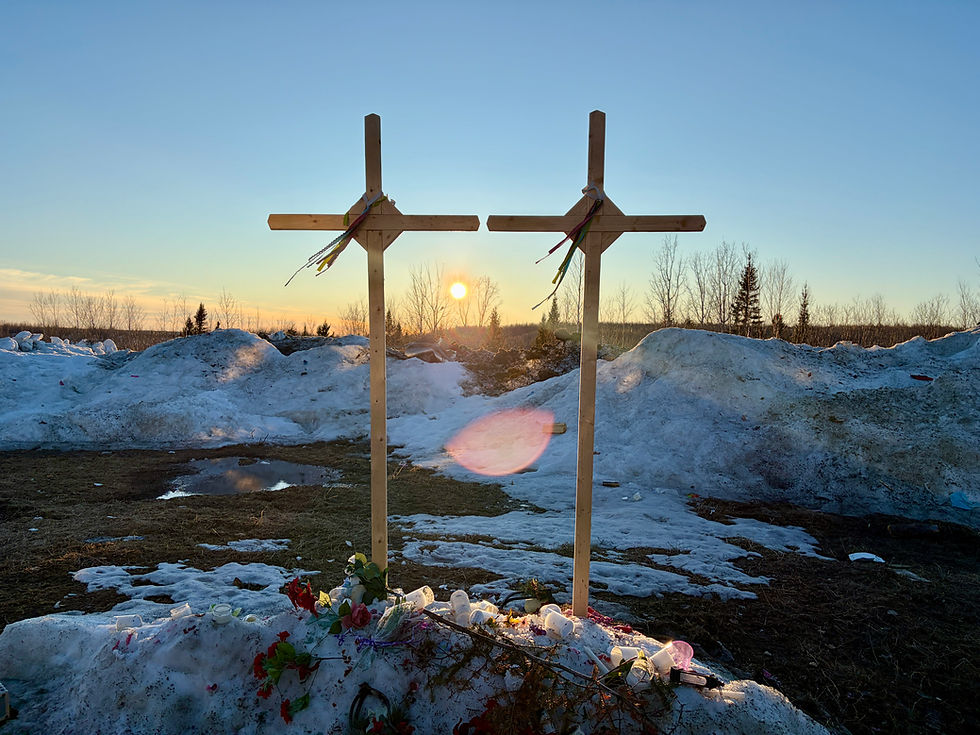
Suddenly, she stopped on the road. There were two crosses by the roadside, with flowers on the ground.
“This is where the shooting happened,” she said.
I had heard about it before - an email from the university, social media, the news. Someone from Toronto had asked me about it. But it had all felt distant.
And now here I was, right at the site. Two lives lost too soon.
We drove on.
Later, we talked about school. She had gone to Ottawa for university and studied social sciences.
“Did you ever think of staying?” I asked.
“No. Home is home.”
We kept driving toward the church.
Sunday, April 26, 2026
Mistissini → Chibougamau → Val d'Or → Montréal
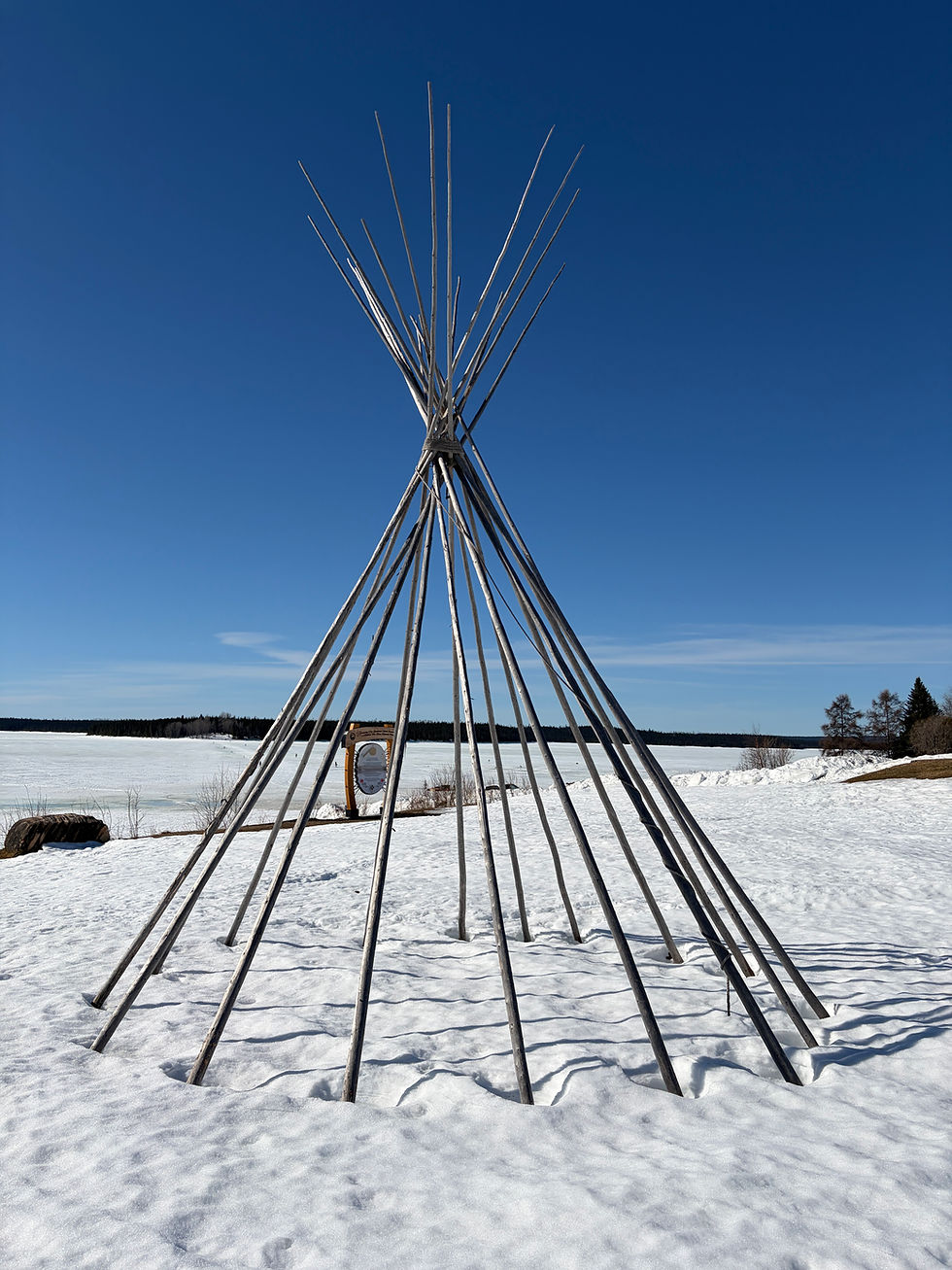
That morning, I went for a walk. I made my way out toward the ice, where the small plane had been parked the night before. It was gone. I asked about it, and Suzanne explained that it was a bush plane. It could land on the ice in the winter, and on water in the summer. People used it to go out into the bush.
We went to Sunday service, and afterwards she drove me back to the transit.
« À la prochaine, » I said, not really knowing when that would be.
The taxi driver had arrived early. He had another pickup along the way. We drove out past the barricade, then back through the long stretch of forest toward Chibougamau.
We arrived at the airport. It felt open, with high wooden ceilings and light coming in. I boarded the plane and we set off for Montréal.


Did you try the moose meat at all? Also glad that taxi was reimbursed! Quite the adventure :)
May God continue to guide protect and make you a blessing Michelle 🥰