Back in Kuujjuaq

Apr 3
9 min read
Monday, March 23, 2026
Kuujjuaq, Nunavik

The hallway was already full when I arrived.
Patients lined both sides, sitting quietly, some standing, some leaning against the wall. They had all been flown in from Wakeham Bay (Kangiqsujuaq) that morning for clinic.
They were all waiting for me. It was only 2 PM.
That morning, in the boarding area, I felt a bit uneasy and out of place. I move in and out of the region, between the North and a life largely based in the South. Even when I return, it feels like stepping into something that has continued without me. Then I remembered I had packed my own UTHC hoodie, the one given to healthcare workers across the Ungava coast.
On the plane, I began to recognise people. Across from my row was someone who had previously worked at the hospital. A few rows ahead, another physician. Those small points of familiarity made the arrival feel less abrupt.
At the airport, Stéphanie and Sandrine were there to receive me. My suitcase was not.
Last year, my luggage did not arrive. It was eventually found two months later by a persistent and kind-hearted airline employee. I thought of that immediately as I stood watching the conveyor belt empty. This time, I had borrowed a suitcase. My own equipment was locked away in storage in Montréal after an unexpected change in access. The margin for error felt thin.
Stéphanie went to speak with the counter. I stayed by the belt. When the next batch of luggage came through and I saw the suitcase, the relief was immediate.
At the transit, I was placed upstairs, where the trainees usually stay. They were out in the villages that week, so the arrangement had shifted. I set my things down and turned on the tap.
No water.
There was barely enough time to register the problem, eat a few quick bites, and reorganise my things before heading to the hospital.
There were charts, a room, and a hallway full of patients waiting for me. I took out the skin prick testing kit and began. The charts were written in French, and the nurse was more comfortable in French. The patients spoke Inuktitut and English. I translated the charts as I went, more comfortably in one direction than the other.
I had already begun testing on two patients and set my timer before realising I did not even have a ruler.
Much of the work depended on adapting in real time, and I felt like I was working slightly blind. I moved from one patient to the next, taking histories, starting tests, and gradually telling Nancy what I needed as we went.
For the food challenges, I went back and forth to the kitchen asking for ingredients. I had done this before on my previous trips, and they recognised the process. Each time I asked, they gave more than I needed without hesitation. At one point, they handed me a full cup of chocolate chips. I started eating them in between patients as the afternoon went on.
Many had been waiting without knowing when they would be seen. There was no visible impatience. Some even recognised me from two years ago when I had last visited Wakeham, and greeted me warmly.
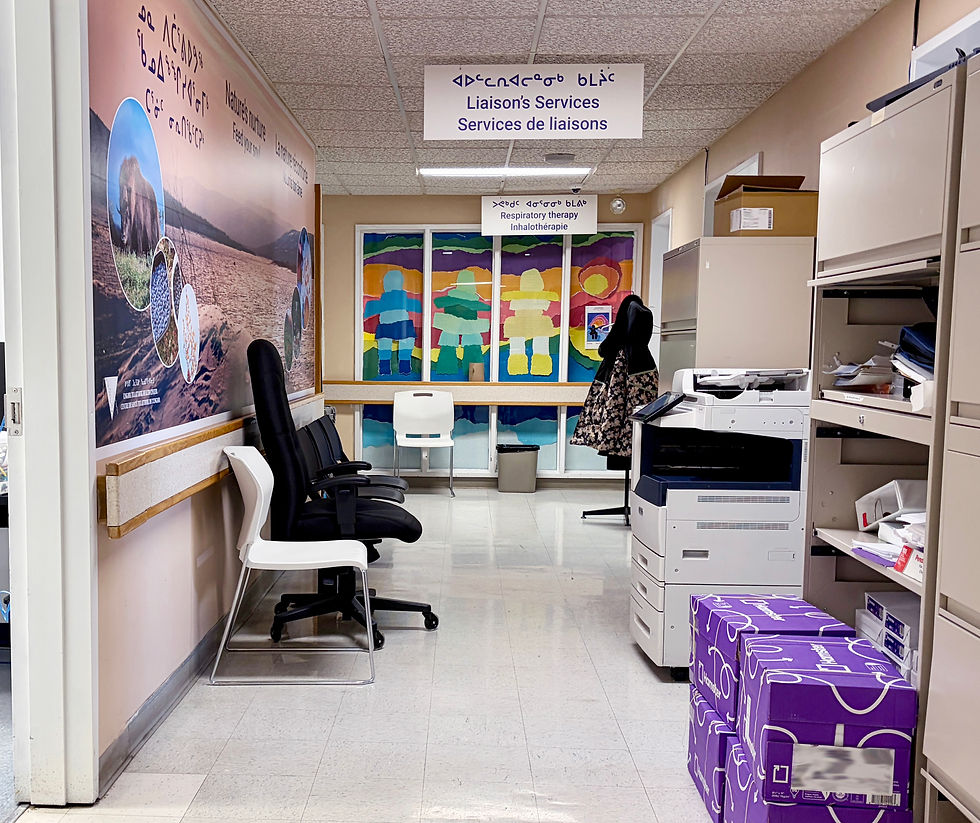
Finally, the hallway was empty. Nancy checked in and later handed me meal tickets, encouraging me to pick up dinner before the kitchen closed. A technician noticed that I did not have access to water and gave me a pack of baby wipes. These small acts made the work possible.
Before leaving, we reviewed the list and began to redistribute patients, prioritising those who had been flown in from other communities. Seventy-four were booked under my name between Monday and Thursday. There was an assumption I would leave Friday when I was in fact leaving Saturday. I had also come without a resident, which made the volume feel even more apparent. The plan shifted accordingly.
Upon leaving the hospital, I realised I had not brought any water with me. I considered going with a container but decided to eat first and figure it out after.
At the transit, I turned on the tap just to see. This time, the water ran. It felt like a hallelujah.
Dinner was cheese tortellini from the cafeteria and steamed chive and egg baozi from home. The rest of the evening was spent finishing notes. I was simply thankful to drink, shower, and reset before the next day.
Tuesday - Wednesday, March 24-25, 2026

By the second and third day, a rhythm had settled in. The pace had not slowed, but it had become more continuous than chaotic. Patients arrived from George River (Kangiqsualujjuaq) and Quaqtaq, with some from Kuujjuaq interspersed.
Nancy was coordinating the flow, managing appointments, and keeping track of who needed to be seen before flights out. Patients were often not booked to leave until their testing was complete, which gave me time to maximise what could be done before they returned home.
At the same time, patients themselves were actively part of the process. Many appointments extended over multiple days, with families returning until everything was complete. One patient reported a pomegranate allergy, and after taking the history, her father returned that afternoon with pomegranate for testing. Another patient had possible FPIES to arctic char, and the grandmother later brought back a fatty piece to test. One mother returned with pasta and lobster for a seafood challenge. Another grandmother explained each step of the testing to her curious grandson as we went along.
There were also familiar connections. I met relatives of patients and community members I had come to know over the past few years, including some from Tasiujaq, and there was a sense of continuity across visits.
Some moments did not fit neatly into expectations. One lady described a severe reaction to tea. I went to the cafeteria to make a cup of tea and did skin testing, which was positive. It seemed unusual enough that I did a quick literature search and found a case that had been published over twenty years ago. It was a real thing. She left visibly pleased.
During lunch, I discussed a potential anaphylaxis research project with some of the family physicians, trying to understand whether it would be feasible in this setting. Earlier, I had also spoken with our research coordinator down south and found myself explaining how things function on the ground. The conversations with the family physicians made clearer the gap between what is envisioned and what is workable here. Even basic systems worked differently than what I was used to. Charts were partly scanned but not easily searchable, so much of the work still depended on physically locating and moving through paper files one by one. It made me realise how much of what we consider “standard workflow” depends on infrastructure that isn’t always present here.
A separate conversation with a pharmacist highlighted similar realities. In practice, access to certain medications felt more variable than I am used to in the South, with decisions often made case by case.

That evening, I went out with some of the family physicians for karaoke. One of the highlights was watching a man in a nassak and parka, his fox fur-lined hood pulled over his face, belt out a song to a cheering room. It was unexpectedly fun.
Thursday, March 26, 2026
Andrea Makiuk Roy dropped by that morning. We had been introduced by email the day before through one of the family physicians, but I had not yet had a chance to respond. She greeted me and offered to share her coffee. We went to the cafeteria to boil water for Nescafé Gold and continued our conversation there. Others passed by and asked for some, and she shared it readily.
She moved between English, French, and Inuktitut and seemed to know many people in the hospital, often dropping by throughout the day. Later in the afternoon, I showed her my Makivvik hat. Her eyes lit up. She described the organisation as being for the people, meant to benefit communities across the region. She spoke about being an Inuk woman with unmistakable pride.
Friday, March 27, 2026

I started the day with an overripe plantain, an egg, and a bit of flour. The bright morning sun made it feel like a good day for pancakes. Andrea dropped by later that morning, and I gave her some. She was happy to receive them and had them for lunch with maple syrup.
The slower pace of the morning allowed for more time to speak with patients beyond their immediate concerns. Conversations extended into daily life and experiences in the region. I also learned more about Atanniuvik, a new Nunavik-led initiative where research is reviewed locally and shaped to benefit the communities.
The afternoon began with intradermal testing for antibiotics, which required preparing everything from scratch. The patient had a potentially serious reaction, so I approached it cautiously. It was not something the pharmacy or nursing team were used to, and it took several trips back and forth to organise what was needed. Eventually, we were able to get some answers.
In the late afternoon, I debriefed with the nursing team and pharmacist. By that point, there had been 57 encounters over the week, most involving food challenges and skin testing, with a few drug challenges. I also went through the lab results from patients seen earlier and made plans for follow-up. Finally, I packed up the clinic room and concluded the week.
As I walked towards the transit, the sky glowed bright pink. I realised I was not the only one staying there. A resident had arrived from Quaqtaq that day and would be in Kuujjuaq for the week. A medical student was still waiting in George River for his flight back to Kuujjuaq.
We had dinner together, and I heard about her experiences in different Northern and Indigenous communities across Canada. The student eventually arrived around 10 PM, exhausted after finding his way in late. He had not eaten, but the resident had saved him food from the hospital cafeteria.
The resident mentioned that there had been no water at the transit for nearly 30 hours, and they had been managing with what remained. She had left just an hour before I arrived, not knowing I would be there.
Saturday, March 28, 2026

I went for a morning walk before heading to the airport. It was around −29°C with windchill in the high -30’s, but it did not feel harsh. The snow reflected the sun so brightly that I needed sunglasses. The powdery snow squeaked under my boots, and the wind carried loose snow across the road like smoke.
I walked towards the airport to look out over the town, then back towards Kuujjuaq Inn to warm up. I sat for a while and leafed through the local newspaper, reading about events in the region and a missionary’s journey along the Ungava coast in the early 1800's. The innkeeper came by and let me know I could help myself to coffee.
I continued along the road on the other side of town. A few people spoke to me in Inuktitut as they passed. I did not understand, but gathered from gestures that I should walk on the other side of the road.
Back at the transit, I packed up and got ready to leave. Dr. Noah Brosseau from the Nunavik Research Centre picked me up, and we went to Dr. Michael Kwan’s place for lunch. Michael had prepared a meal with salmon that had been caught over the summer, along with turmeric rice, mango salsa, and Buddha’s delight. He served jasmine tea, along with a white tea Meng had gifted from a previous visit.
The conversation moved between research and daily life in Nunavik. When I asked what fish was available at the time, they said most of it came from ice fishing, with lake trout being the main catch.
We spoke about muktuk (beluga whale) and how it is eaten. I thought back to my first time trying it in Quaqtaq a few years earlier, sitting on a cardboard box on the floor and awkwardly cutting the raw skin with an ulu. I tasted it first on its own, then with soy sauce and wasabi, and later with different spices. Michael suggested steaming it briefly before serving it with green onion, ginger, and soy.
Michael described his first time eating raw Arctic char dipped in fermented seal oil. The conversation shifted to kanajuq (sculpin), and when Noah showed me a photo, I understood why this spiky bottom-dweller was called “ugly fish.” He also spoke about witnessing a herd of muskox on a recent trip, and how they form a circle when threatened, protecting the young within.
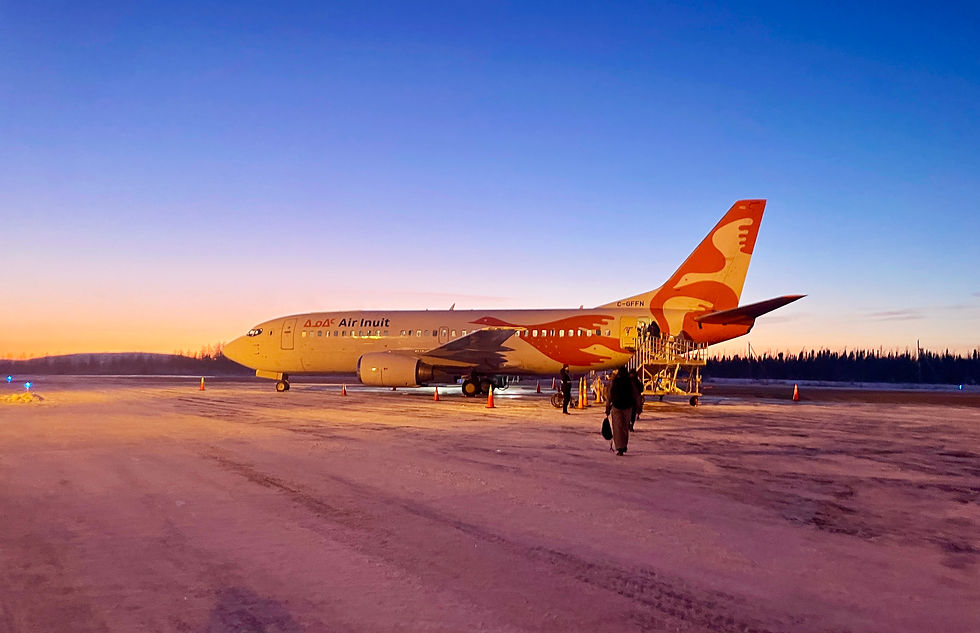
Time passed quickly, and before long it was time to head back to the airport. On the plane, I recognised more faces from earlier in the week. As we landed in Montréal, the North no longer felt distant, but alive again, a place where I had been welcomed back.


Comments