Where Everything Intersects: Kuujjuaq, Week 2

Nov 16, 2025
11 min read
Updated: Nov 17, 2025

Monday, November 10
Kuujjuaq, Nunavik
In the morning, I walked to the hospital to begin my second week in Kuujjuaq. Nancy was already there with a trolley marked “réservé pour spécialiste,” charts stacked neatly and pink Post-its marking important details. She offered me a cup of coffee as I settled in. The pharmacist had ordered a full set of supplies for testing, including extracts for foods, environmental allergens, venoms, and duotips. It felt like a warm welcome.
A nurse from chronic care came by to update me on a patient we had started on a biologic. It was the first one I had initiated in the region and setting it up had required some adapting to local realities. Seeing the process work out felt rewarding given the challenges of access.

I thought my first patient was booked for 9h45, so I took time to set up the two rooms I would use for the week. Then I looked down the hallway and saw a line of people already waiting. The clinic had actually started at nine. The schedule ran every fifteen minutes, and my residents weren’t there yet. They were scheduled to arrive that afternoon but messaged me that their plane was delayed. I tried not to panic. It meant doing skin tests, running drug challenges, and making quick decisions on my own.
Among the morning patients were someone who needed a ceftriaxone challenge. She had previously reacted when I gave her another antibiotic, so I decided to test ceftriaxone as a possible alternative if needed in the future. I picked up the prescription from the pharmacy, then went upstairs to gather the supplies and prepare the medication. One of the nurses helped me find the lidocaine to mix with the antibiotic for the intramuscular injection. The observation period went well, and we were both relieved.
By lunchtime, I checked again. Had the residents landed? Nancy looked at her phone and said the plane had touched down “ten seconds ago.” But as the lunch hour went on, there was still no sign of them. Who was picking them up, and where were they headed? I just kept going, knowing that somehow things would work out.
I finally sat down with a bowl of cream of carrot soup and coleslaw from the cafeteria when Nancy passed by. «Tout est sous contrôle ? »
“Uh… yes…?”
A few minutes later, Guy came by to check in. The team was exceptionally busy. Several specialists were still stuck in villages because flights hadn’t taken off, and finding accommodation was difficult. He said I was more popular than expected—he had only started calling patients the day before and had managed to fill half the clinic just like that. They were doing the best they could under the circumstances.
Around 13h30, Meng Zhu Shi arrived, a third-year internal medicine resident and future allergist. Fourty-five minutes later, Badria Alkazemi, a second-year dermatology resident, appeared, rolling a small suitcase down the corridor. They had brought pancakes and muffins for our milk and egg challenges—some with milk and no egg, others the reverse. I helped them settle in, and once they did, the rest of the day flowed more smoothly.
In the evening, we had dinner at the transit and met Mégan, a family medicine resident and Samuel, a medical student. We tasted the pancakes and muffins that Meng and Badria had brought and talked about how complicated food ladders can be for families to follow at home. Then Mégan shared a gift from a patient that day — a freshly caught arctic char. I sliced it while still partly frozen, tried it plain first, then with soy sauce and Wafu sesame sauce. It tasted fresh and clean, like the northern water it came from.
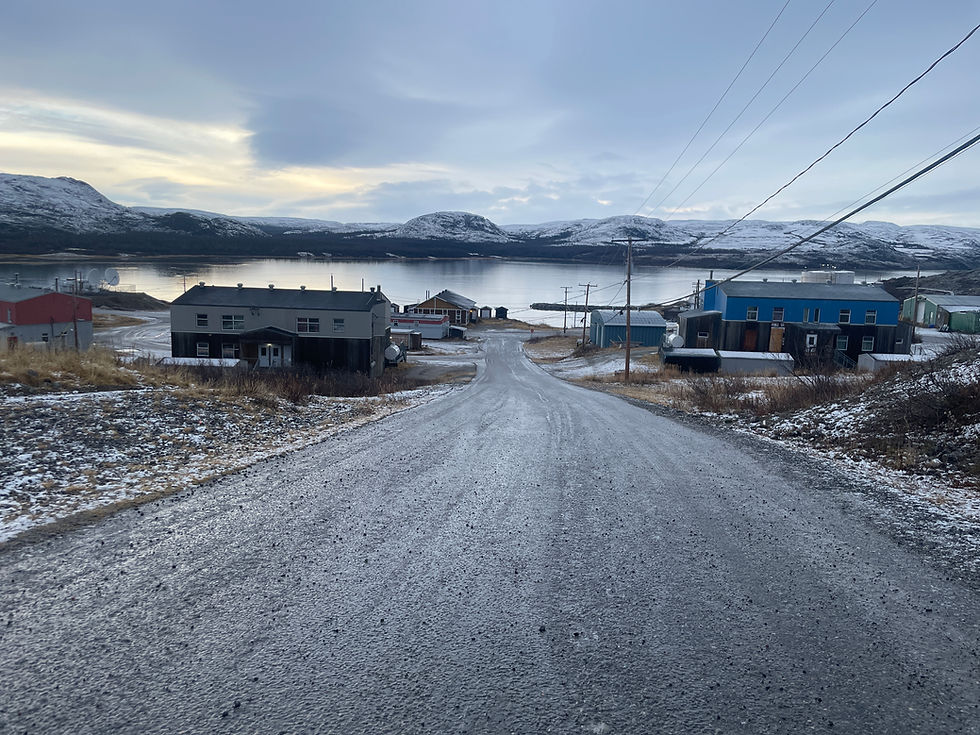
I walked home afterward through the snow with light flurries in the air, the street to myself and the bright lights from the hill in the distance.

Tuesday, November 11
Before the day began, I saw Nancy just outside the hospital.
« Aujourd’hui, je fais le GI, le dentiste et la clinique des spécialistes… et l’interprète qui aide à appeler les patients ne peut pas venir. »
I laughed and replied, « Tu fais le travail de trois personnes aujourd’hui! »
The morning turned out to be slow. I turned to Josée Constant, the adjointe administrative, and said, « Hier matin, j’étais débordée…and now we have the full team but nothing to do. »
We tried calling patients to fill the schedule, but not many answered. Eventually, we realized why: November 11 was a holiday, the anniversary of the James Bay and Northern Québec Agreement, and of course, national Remembrance Day.

We still made the most of it, but by mid-afternoon, holiday-itis had set in.
Annie Gosselin stopped by for a run de lait at the Kuujjuaq hospital, on a stopover to the south from George River. It was nice to see her again. On Saturday, when Michael Aw and I had crossed paths with her on our hike, we had said « à la prochaine », thinking it would be a long time before the next trip. But here she was.
That evening at the transit, we put together a small feast: pan-fried vegetarian dumplings, Chinese cucumber salad, Thai soup, with General Tao and salad from the cafeteria. The others cooked the char from yesterday.

Later, we went to Elisapie’s concert at the Katittavik Townhall, part of the celebration marking both Makivvik’s 50th anniversary and Remembrance Day. The MC opened the show, saying, “Hope you’ll be entertained.”
Elisapie appeared in a flowing, bird-like outfit. She had recently won a Félix Award in Québec for Indigenous Artist of the Year. The concert was exceptional, weaving between pop, rock, and other styles. Two teenage Inuit girls closed the evening with a powerful throat-singing duet that slowly quieted to silence. Then the rock band struck a final chord, and the crowd roared back to life.
I remembered marking down her concert during Jazz Festival last summer, but it was scheduled for 11pm on a Wednesday, and I couldn’t go. I had felt disappointed at the time. I didn’t realize then that I would one day hear her sing in Kuujjuaq, on Indigenous land and among her own people, and to celebrate an important commemoration. It felt like a small dream come true at the right time and in the right place.
After the concert, the town gathered for fireworks. I joined two colleagues on a hill to watch the bursts scatter across the dark sky. The fireworks felt unexpectedly touching. Maybe it was because we were in the North, or because it was a day of celebration, but I honestly didn’t know quite why.

Wednesday, November 12
This morning, we returned to a full liaison team including two interpreters. One woman asked if we needed help. Guy told her we had many calls and coordination tasks to do and asked if she could return in the afternoon. She agreed, and just like that she joined the team.
A physician from George River called to discuss several patients we had already seen for drug challenges. These were cases where we had completed an initial step during this trip but still had more to do. We went through each case carefully so their team would have clear next steps.
At lunch, I enjoyed an excellent meal of coleslaw, heart of palm salad, cabbage soup and carrot cake with cream cheese frosting. After a short walk outside, Badria, Meng and I returned to the clinic. In the early afternoon, Meng and I sat with Dr. Benjamin Perron, one of the family doctors stationed in Kuujjuaq. We reviewed an amoxicillin challenge protocol he was drafting for the Ungava region and talked through some of our ongoing outreach work.
Partway through our meeting, Nancy peeked in and said, « Tu viens? On est rendu avec beaucoup de patients. »
I stepped into the hallway and saw that it was full of people waiting for us. I quickly opened another room to improve the workflow.
One patient had a suspected salmon allergy. I went to the kitchen to ask if a piece of salmon was available for a food challenge. They did not have any prepared, but the head chef offered a frozen piece and said that if we gave advance notice next time, they could plan with us. It felt like a genuine moment of teamwork.
Around three o’clock, someone was taking photos through the window. I did not think much of it at the time and kept working. Later, I learned it had been a magnificent pink and purple sunset, but we were too absorbed in the clinic to look up.
By six o’clock, another referral came from upstairs from Dr Catherine Sarrasin. We were still on site, so we saw the patient, and the family was very appreciative. Dinner at the hospital cafeteria was ravioli in mushroom cream sauce and couscous, chickpea stew and vegetables. It was comforting and helped us finish the day.

After work, we walked to the sewing centre. We had heard there was a sewing class from six to nine, but it turned out there was no class at all. The space was open for anyone who wanted to work on their projects, and people could come in and use the equipment as they needed. One woman was sewing a jacket for her son.
Later in the evening, we went for karaoke with the medical team. I sang a few songs, and it was fun to unwind together after a long day. Dr. Arnaud Messier-Maynard, another family doctor based in Kuujjuaq, spoke about how people in the North work side by side, adapting to each other and finding a way forward as a team. It reflects the strong sense of purpose and community that exists here.
Thursday, November 13
I arrived at the hospital to learn that the computer system had been taken down by a virus. With everything offline, we had no schedule and no way of knowing who was supposed to be seen that day.
A few minutes later, Noah Brousseau messaged me out of the blue. Michael Kwan was at the Nunavik Research Centre and could give me a lift to Hunter Support right now. It felt like an opening in the middle of the chaos, so I went.
Reception was poor along the road. On the way back, a message from Badria finally came through: "Call Guy right away."
Guy: “The Wakeham Bay plane is grounded by a blizzard. Thirteen patients can’t fly in. Should we cancel clinic?”
Me: “Wha?”
Guy: “Didn’t Nancy tell you?”
Then I remembered. Nancy had casually mentioned the day before that flights were likely to be cancelled.
« L’avion est annulé… il y a une tempête… tu peux visiter Wakeham la prochaine fois… c’est beau. »
I hadn’t fully processed it.
I refocused on the situation and turned to Nancy Bouchard, who was covering for Nancy Veilleux as liaison nurse.
Nancy: « Bon, on n’a pas de liste aujourd’hui. Le système est down. Je ne sais même pas qui est censé venir. »
Me: « Ah non non, on sauve la journée. »
Nancy: « Mais, on n’a pas les demandes de consult, pas les raisons de visite, rien… »
Me: “We’ll just open each chart, see why they’re here, and call them.”
So Nancy and the team, with Valérie Poirier, Julie Lauzon, and the interpreters, worked the phones “the old-fashioned way.” They managed to fill the entire day. When I thanked them, Nancy just said, « On travaille fort. » And they really did.
I also had several meetings across the hospital that had been arranged on short notice. In the meantime, Meng and Badria kept the clinic running. I was amazed by how willing hospital staff were to help each other, even with limited rooms and last-minute changes.
Later that evening, Noah picked us up to go to Michael Kwan’s place for dinner. Finding his car took some effort because reception kept dropping and even the landline cut out once. We eventually found him outside the Kuujjuaq Inn.
At his place, Michael had prepared a full home-cooked meal: stuffed porcini mushrooms with roasted pear, wild-caught salmon with maple-dijon sauce, turmeric rice, and vegetables. The biggest surprise was the cheese plate with grapes and Chinese tea. It wasn’t the kind of meal I expected to have up north, and that made it even more memorable.
Over dinner, he talked about how he ended up in Kuujjuaq, a story also featured in Tarralik Magazine. We spent the rest of the evening sharing stories and laughing around the table.
Friday, November 14

It was my last morning in Kuujjuaq, about –12 °C but bright and clear. I woke up early to finish packing, put the leftover food in my cooler, washed the bedding, and walked to the hospital in the calm morning sun.
When I arrived, the system was still down. Nancy and I triaged patients whom the interpreters phoned the “old-fashioned way”, while Meng and Badria saw them one by one.
I was still trying to sort out all the moving pieces for our travel. Guy had told me the day before that Fridays fill up quickly and that people can get bumped from flights. He planned to call the counter in the morning with an update, but by the time morning came nothing was confirmed. I was not sure if I should borrow the on-call car and drive to the airport early, or if online check-in was an option. We were all staying in different parts of town, so coordinating everything while running clinic took a bit of juggling.
We also hoped to visit Michael Kwan at the Nunavik Research Centre. I thought we might finish clinic around noon, but it was difficult to predict. I considered staying behind if anyone else needed to be seen, and letting Meng and Badria have a bit of time to explore.
I messaged Michael saying I would confirm around noon. He said it was fine and reminded us to prioritize checking in. We decided he come to the hospital around 13h45 to pick up Meng and Badria, and I could join afterward if needed. Our flight was at 16h30.
When I went to update Guy, he was in a room with Nancy Bouchard and Julie, all in the middle of a serious discussion. He looked up for a moment and said, “Sorry, we have an emergency situation and the whole team is tied up. Could you be autonomous for the afternoon?”
"Yes, of course."
We arranged a safe place to leave the keys, then I told Michael and the residents that I would join them for the rest of the afternoon. Michael drove us to the airport so we could check in, and afterward he brought us to the Nunavik Research Centre. He walked us through the ongoing work in toxicology, avian science and environmental monitoring, and explained how the research is shaped by local priorities and directly relevant to the people of the region.

We met Katherine Snowball, a technician preparing beluga teeth to determine age. She had striking facial and arm tattoos and mentioned that they held personal meaning for her. She explained that traditional tattooing was once done with soot, and that she chose a modern version using ink and bone that followed the same spirit.
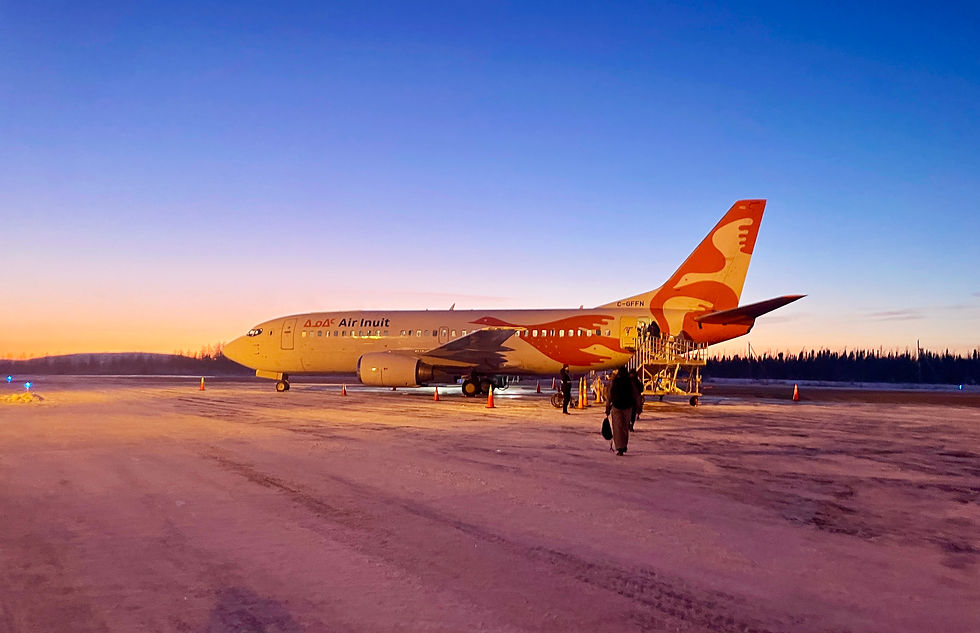
As we were wrapping up the tour of the research centre around 14h50, the sky was already turning pink, purple and gold. It was beautiful to see the sun set like that so early in the day. We made a quick stop at the new Co-op store where I picked up smoked trout, then gathered our luggage from the different houses and headed to the airport.


I love reading about your adventures Michelle! Way to improvise and fill up your Clinic last minute!