The day began early at the Air Inuit check-in counter at Montréal–Trudeau airport with my resident, Dr Michael Aw, a PGY-3 in Internal Medicine at McGill and future allergist. This was my seventh trip up north, yet the feeling never fades. I looked forward experiencing the wide-open space of the North to bring me back clarity. As we boarded the plane, that familiar mix of excitement and focus settled in once again.
When we landed, I discovered my phone lost service, a first for me in Kuujjuaq. While I was fumbling for quarters to use the pay phone, Dr Michael Kwan was already waiting at the terminal. I had only reached out to him that morning from the Montréal airport on a whim, and he had kindly offered to meet us. Michael Kwan is one of our research partners, faithfully collecting pollen samples for analysis by Aerobiology Research Labs in Nepean, Ontario.
With a four-hour layover ahead, he brought us to his place for tea and conversation. He mentioned that flight schedules in Nunavik had been unpredictable lately, with overbookings and delays that left travellers waiting for days. We counted ourselves fortunate that our connection to Tasiujaq was still on schedule. My own tickets had only been confirmed a few days earlier due to some confusion about the booking process, which the DSP (direction des services professionnels) kindly helped resolve last-minute.
At the Nunavik Research Centre, we met Peter May, brother of the Governor General Mary Simon and of the legendary Johnny May, remembered for his Christmas candy drops over Kuujjuaq. Peter has been part of the research centre since its early days and carries an encyclopedic knowledge of local ecosystems. What stood out most was his humility, blended with decades of knowledge and lived experience as both an avian expert and a leader in the community.
Later in the afternoon, we took the short flight to Tasiujaq. As we stood figuring out our next move, a woman at the airport asked, “Are you going to the hotel?” Within minutes, our bags were loaded, and we were on our way. Checking in was smooth for me, though Michael Aw’s reservation wasn’t showing in the system. The hotel staff quickly found a solution and arranged a room for him without difficulty. My own bag, however, had not arrived, and I realized I had accidentally left it in Michael Kwan’s car back in Kuujjuaq. That meant wearing the same clothes for the next three days.
The hotel kitchen was well stocked, and we met a few friendly faces in the hallway. We settled in that evening, preparing a dinner of linguine with tomato sauce and parmesan, and Japanese-style cucumber salad.
Tuesday, November 4
Tasiujaq, Nunavik
Our first morning in Tasiujaq began at the CLSC (centre local de services communautaires). The building was instantly recognizable to me as it had the same layout as the other clinics I had visited in the region. But I did not know anyone yet and was not sure what to expect. We introduced ourselves to the head nurse and the rest of the team, who welcomed us warmly. Within minutes, we were shown to our room and handed a list of patients for the day.
One child we saw had a history of milk anaphylaxis, though the details suggested the reaction might have been less severe than initially thought. The skin test to fresh milk was borderline, and after discussing it with the mother, we decided to reintroduce milk cautiously. Allergists often use a “milk ladder” to guide gradual reintroduction. It begins with baked goods such as cookies or muffins, progresses to pancakes, then to foods with more direct milk content like pizza or boiled milk, and ends with fresh milk or ice cream. Since this child had never tried pizza before, we started with pancakes, the second step of the ladder.
Shelley, one of the nurses, offered to make pancakes during her lunch break. The child’s mother also brought bannock made with milk, using her own mother’s recipe. As we conducted the challenge, the smell of bannock filled the room while the mother showed us videos of her family hunting beluga whales. What began as a clinical test became a moment of cultural connection and learning.
Outside, the landscape had changed completely. In the morning, the inlet was full, the water glimmering against the shore. By noon, it had drained away, revealing wide stretches of exposed sand and boats resting on dry ground. Tasiujaq is known for having the highest tides in the world, reaching up to sixteen metres between high and low tide, greater even than the Bay of Fundy. Watching the transformation felt almost like watching the land breathe, the water pulling back into silence before returning hours later.
We ended the evening back at the hotel with a dinner of pasta and a West African–inspired sunflower seed soup I had brought from home, served with yam fufu we found on the shelf, and oven-broiled napa cabbage. Over dinner, we shared conversation with the visiting dentist and dental assistant who were also staying there. What had begun as a first day in an unfamiliar environment ended with meal among teammates and new friends.
As we began our second and final day in Tasiujaq, one patient that morning required a type of testing we do not routinely perform in allergy. In the South, patients often wait six to twelve months for this kind of assessment, but for her, it could be never. She had been describing this problem for years, yet no one had been able to investigate it properly.
I came up with a plan: if she could come to Kuujjuaq the following week, we could arrange to have the test done there. It was a long shot, but one I was willing to try. I reached out to a physician colleague in Montréal for help. Despite a full schedule and the fact that we had never met, he kindly offered to have his nurse prepare the testing materials for my resident to bring north on Monday.
By late morning, we began packing up for our flight. The departure was scheduled for 12h30, but when we arrived at the airport, we learned it had been delayed until 14h45. James, the social worker, offered to drive us back to his house for lunch while we waited. At one point, James mentioned that he sings lullabies to his dogs. We prepared a simple meal of pizza and salad with homemade dressing and nuts. As the pizza baked, he picked up his guitar and we found ourselves in an impromptu singalong to Stand by Me, then Hallelujah.
Not long after, Ben, our driver and CLSC security guard, came by with an update from his friends at Air Inuit. The flight time had changed again, this time earlier. We immediately left towards the airport and boarded our flight. At the Kuujjuaq airport, Michael Kwan was waiting with my bag. Somehow our timing aligned perfectly. While waiting to re-board our plane to George River, he shared how he steamed beluga whale with soy sauce, spring onions, and ginger, just like a Chinese fish.
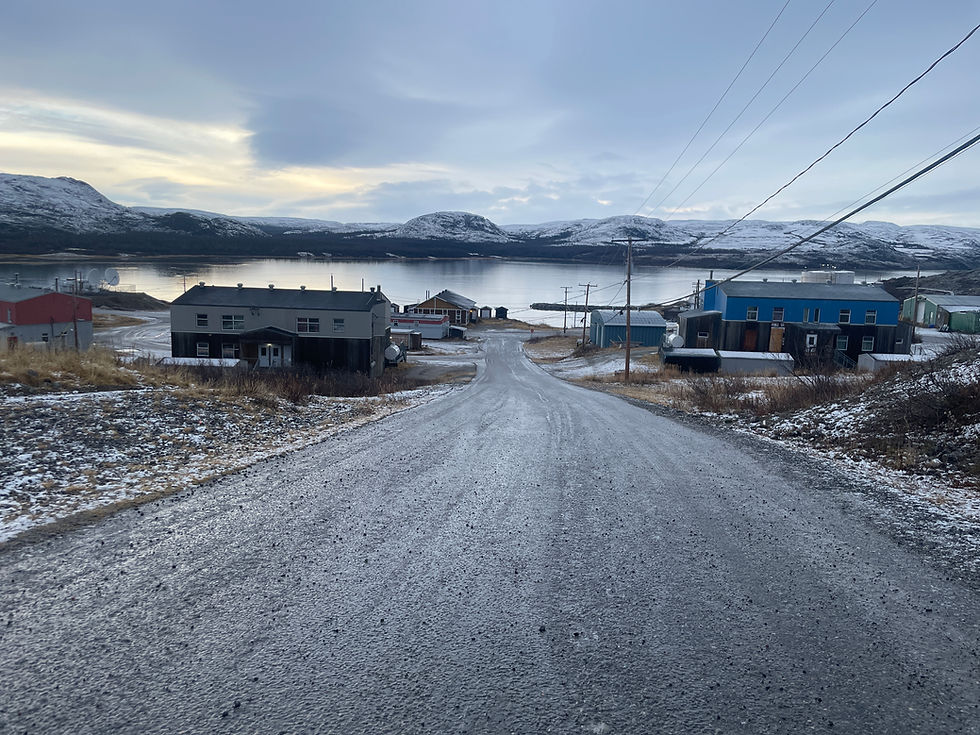
By late afternoon, we landed in George River. It was already pitch black, though not even four o’clock. It was a new town, and I didn’t know anyone. From the airport, I called the Co-op Hotel to arrange a pickup, and the woman who answered spoke kindly and came to meet us. We could not find my hotel reservation. I tried calling a few numbers in Kuujjuaq, but it was already the end of the day, and no one was answering. She gave me an understanding look and quietly figured something out.
A short while later, I learned that I was actually supposed to be staying in the transit house. Apparently, a driver had been at the airport, but we did not know his name or that he was expected. Now he was on his way to pick me up. I quickly repacked my bags and was eventually brought to the transit.
Then, at the hotel, we shared another dinner of pasta, sunflower seed butter soup with fufu, and cucumber and tomato salad with sesame dressing. Back at the transit, each guest normally washes their own laundry and bedding for the next person, but as I didn’t see any fresh ones, I washed all the bedding and towels after dinner. I was also excited to finally wear fresh clothes for the first time in several days.
Thursday, November 6
Our first day at the George River CLSC began with a tour from Sophie, the head nurse. The building felt expansive compared to the small clinics we had just come from, though its circular layout made it easy to find our way around. Patients were still being added to the list as we arrived. With the help of our interpreter, we began sorting through names waiting to be seen for allergies locally, and others who had been scheduled for appointments in Montréal but could now be seen here.
I began coordinating the transfer of a patient from Kuujjuaq whose testing we had planned the day before. Communication in the North can be unpredictable, and it often takes several attempts before reaching the right person. Eventually, everything was worked out. I spoke with the Montréal physician to confirm which tests I intended to perform and what supplies to send. Our infirmière liaison from Kuujjuaq Hospital arranged the patient’s flights and accommodation for the five days required for testing. That evening, my resident in Montréal picked up the prepared materials to bring north the following Monday. I was grateful for the persistence of a solid team that made care possible despite seemingly insurmountable challenges.
As the morning went on, the local Inuit staff invited us into the kitchen to share some fresh seaweed they had harvested. We crisped it directly on the stove, giving it an unexpectedly addictive umami crunch. The texture reminded me of the seaweed in soups I’d had growing up.
Another highlight that day was meeting Dr Danielle Mercier. She had sent me a few consults through our online platform, and I had seen her name in various email threads and formation continue webinars on allergy for northern physicians. I recognized her as someone with years of experience up north, much like Dr Johanne Morel. I finally made my in-person hello at the clinic, and she invited us to her place for dinner the next evening.
Friday, November 7
The day started slowly at the clinic. Michael and I arrived ready to see patients, but the waiting room was almost empty. Our interpreter had something come up and was running late. I felt a bit disappointed. It was our last day in George River, and I had expected to do more. I resorted to an old trick from last year in Wakeham Bay when I stayed longer than expected. I started pulling out charts, looking for anyone with an allergy label who could be called in. When our interpreter arrived, I handed her the stack.
The interpreters really are the bridge, both culturally and linguistically. I was always impressed by how easily they could recall chart numbers from memory, knew which families were related, who might be home, and who could come. She started messaging and calling people right away. After lunch, everything changed. The clinic suddenly filled up, and the afternoon turned into organized chaos. We were running multiple drug challenges at once and managing complex cases that required literature searches, anticipated logistical hurdles, and follow-up discussions with my colleagues down south.
The waiting room turned into a fun little conversation as well. One patient had a possible allergy to seal meat. I’d been asking around for a while but couldn’t find any to test. We didn’t have any on hand, and she was about to leave when a woman in the waiting room overheard and said, “Oh, I have some seal at home.” She went home, brought back a frozen piece, and we used it for testing.
It ended up being a long and busy day. Danielle, who had invited us and the nurses for dinner, stopped by, wondering where we’d gone. Finally, Annie Gosselin, one of the guests, replied in her Saguenay accent, “Quand tu pars, je pars. J’ai encore du travail à finir.”
That evening was the first real home I’d stepped into since coming North, and it felt warm and welcoming. The house belonged to Dr Stephen Arnold, a longtime physician in George River who had helped establish many of the local care protocols. Danielle was staying there during her rotation. She had prepared a simple meal that carried a sense of hospitality. Maybe it was the earthy, handmade-looking ceramic pot the soup was served from, the goblets for the drinks, or the nice teacups we used afterward. Or maybe it was Dr Stephen’s pot rack hanging above the kitchen counter.
We started with a leaf salad with toasted pecans and a vinaigrette made with mustard, olive oil, honey and shallots. The main course was a traditional Québec soupe aux pois with homemade whole-wheat bread and butter, followed by pumpkin pie with freshly whipped maple cream and berry green tea. Around the table were Danielle, Jeanette Manuel from home care, Annie, and Michael. I asked the older women what kept them coming back to the north. « C’est comme une addiction, » they replied.
I mentioned how my goal on this visit was to pronounce Kangiqsualujjuaq. Annie said a local kid once told her it sounded like “can you swallow a truck.” Kan / gik / swa / lu / ju / ak. Even though it was butchered, it was memorable and stuck.
Satuday, November 08
Kangiqsualujjuaq → Kuujjuaq
The morning began with packing up and cleaning the transit house. I washed the sheets, did the dishes, and made sure everything was left in good order for the next person.
Before our flight, Michael and I decided to take a hike up one of the hills overlooking George River. The trail was steep in parts, rising about 200 metres above the village, and the climb took us two and a half hours round trip. Two dogs joined us the entire way as if they knew the route. The wind was cool, with light snowfall as we climbed. From the top, the tundra stretched endlessly around us.
Back in the village, we passed by the clinic to look for the guard, but the doors were locked and no one was around. Then we returned to the hotel, where I had a quick snack of Wheat Thins, hummus, and tea. I packed the frozen food into the cooler and waited a little longer for the clinic guard to pick us up. Almost on cue, the hotel staff appeared and kindly offered to drive us to the airport.
The flight to Kuujjuaq was beautiful. The sky had cleared, and a soft yellow hue stretched over the frozen lakes and ridges below. When we landed, Michael Kwan was waiting at the airport to wish us well before Michael Aw boarded his connecting flight back south. Michael Kwan greeted us warmly and handed us each a small package to take home as a little gift from the north.
As we spoke, an overhead announcement rang through the terminal: « Michelle Kwok, s’il vous plaît, présentez-vous au comptoir. »
I excused myself and walked over, where I found Nadine waiting. She had been asked to drive me to my lodging for the weekend. Nadine was kind but a little nervous. She explained that it was a new car and she hadn’t been to this part of town before. By then it was dark, and finding the right house wasn’t easy. When we finally reached the address, the key I had been given didn’t work.
With no phone service, Nadine drove back first to the entrance of a nearby office to try and get wifi, but the network was locked. We then drove to the DSP building to check the key box. None of the keys were clearly labeled, only marked with codes. We called Guy, who confirmed I was given the right place. Nadine spoke into my phone, saying, « Non, non, on a essayé plusieurs fois. La porte ne veut rien savoir! »
After hanging up, she decided, « Prochaine étape, on va à l’hôpital. Quelqu’un va sûrement répondre sur Teams et me dire quoi faire. »
We drove off again. At the hospital entrance, I peeked into the lost-and-found key box, just in case. Inside, Nadine logged onto Teams and began sending messages. She showed me that nearly every place in Kuujjuaq for healthcare workers was already booked.
She turned to me from behind her computer and said « Tu peux aller te trouver quelque chose à manger pendant que j’attends. »
The cafeteria food looked enticing — hot mains with real mashed potatoes, carrot and raisin salad, and date squares. When I came back, she had finally gotten an answer, even though it was five o’clock on a Saturday. The problem wasn’t the key after all. We had the wrong house number written on my envelope.
Nadine laughed and said, « On trouve toujours une solution. »
I replied, « Comme en Afrique. » She smiled - she was Congolaise.
When we finally reached the right house and the key turned smoothly in the lock, I raised my hands in a V sign and shouted, « Victoire ! »
We were both relieved that the long search was finally over. I unpacked my bags in what would be home for the next six days. I was simply glad to rest after a week of travel, hellos and goodbyes, and unexpected challenges. Week 2, I knew, was going to be different.



Love your descriptions of the food 😆 and I SOOOO want to try steamed beluga whale with ginger and soy sauce one day!