The Things You Cannot Unlearn

May 9
9 min read
Sunday, May 3, 2026
Montréal → London → Oxford
I got into Oxford just after 1pm and went immediately to Saïd Business School to leave my suitcase, but the baggage area was full. The porter said not to worry, a programme had just finished, and people would be leaving soon. While waiting, I met someone from a diploma programme who was flying out, originally from Guatemala. We got talking about what it is like coming in and out of Oxford like this. She said it feels like a pause. You come here, it is intense and inspiring, and then you go back to your normal life.
The rest of the day was mostly spent walking around. Oxford feels more familiar now but still separate from everything else. I missed May Day but kept hearing about it. The Magdalen College choir singing at 6am, a tradition going back hundreds of years, people gathering before sunrise and then everything spilling out into the streets after.
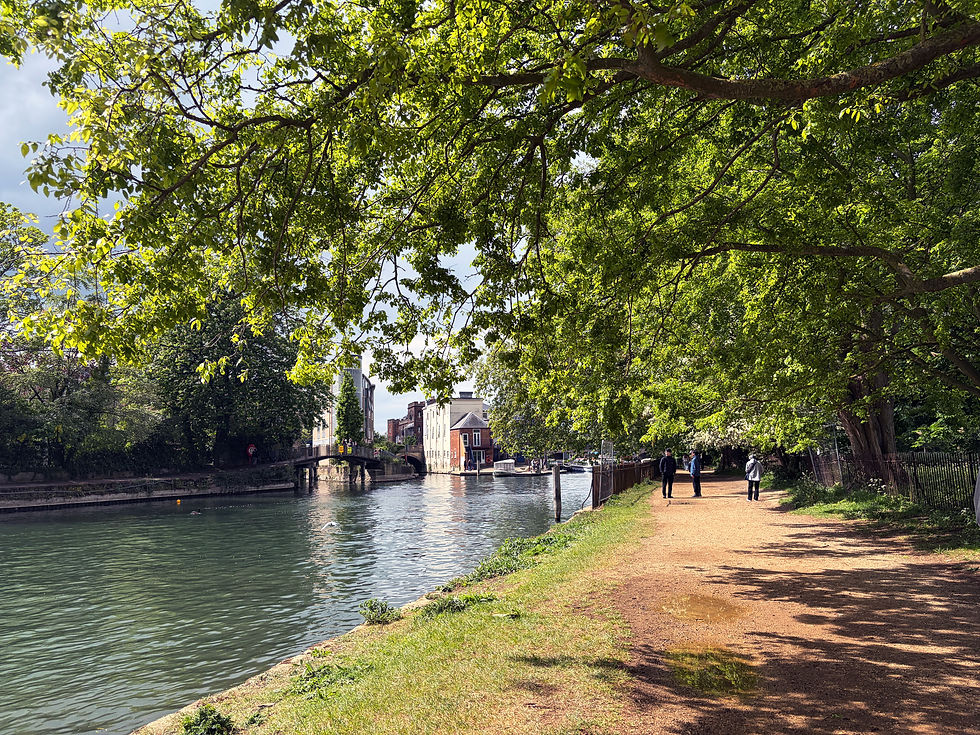
I walked along the river and saw a rowing race going on, like it was just a normal everyday thing.
Monday, May 4, 2026

We met up at Saïd in the morning. I had organised a trip to the Cotswolds for a few of us since it was a bank holiday. There was Ben from Kenya, Mike from Singapore, Sami from Pakistan, Sadia from Dubai, and Hashem from Saudi Arabia.
At the train station we ran into Erin from the US who was heading to London. On the bus, from the top deck, we looked down and saw Dave just arriving with his suitcase.
We went to Blenheim Palace, where Churchill was born. Someone had advised us to skip the main entrance and take a footpath in from the side. We had views of the lake and the palace opening in front of us. It was cold and cloudy, but it was nice to have this company again. We walked through the grounds, watched a jousting show, had lunch, and went through the exhibitions and the state rooms.
That evening the WhatsApp group became more active. Messages coming in. Who is in town, who wants to meet, plans for dinner. It felt like the module had already started, just not in the lecture theatre yet.
Tuesday, May 5, 2026
This week’s module focused on evidence-based healthcare. Coming into it, I felt like I already had a decent handle on things. I have been involved with research since undergrad and took an epidemiology course in residency alongside more informal training. I wasn’t sure why we were spending a full module on this, since not everyone is a clinician and especially not an aspiring researcher.
I soon realised that this was not just about medicine in the clinical sense. It was about how evidence shapes decisions across healthcare, including at the level of systems and policy. Dr Kamal Mahtani and Dr David Nunan were leading the sessions, and you could immediately see the energy between them. They made these ideas feel practical and grounded, especially for global healthcare leaders who still need to engage with evidence properly.
We spent time going through how to appraise papers and structure questions using PICO. But what matters is what comes before. Whether you are asking the right question in the first place, and whether it matters to the patient and the context you are working in.
One of Kamal’s patients asked whether a breathing device could lower blood pressure and reduce the need for medication. I probably would have answered it on the spot, maybe pulled up some evidence, but then moved on. Kamal said he would look into it, and it eventually became the basis for a systematic review. That paper went on to influence policy at the level of the British Heart Foundation.
At lunch I was talking to Syahira from Malaysia, who was from Cohort 3 and joining us for a few modules. She mentioned that while her cohort had liked Module 3 on systems leadership, this one on evidence-based medicine ended up being their favourite, because it felt easier to grasp and apply.

In the early evening, we went punting. We started at the boathouse with some light food, then headed out in groups of four to six per boat, each with a long pole and an oar. Dean stood at the back of our long boat and pushed it against the riverbed with a pole to steer. He made it look effortless, but when I tried, our boat kept turning in circles and drifting into the banks. The other boats were trying to figure it out too, with varying degrees of success. It was one of the highlights of the module.
Wednesday, May 6, 2026
I started the morning with an oat cappuccino from the clubhouse, which somehow always seems to have the best coffee. They also served the usual homemade granola with maple syrup, nuts, seeds, and coconut.
At the entrance to the lecture theatre were snacks people had brought from home. Bahaa from Egypt had brought sweetly addictive mulberries (توت) and different types of dates. Bell from Hong Kong shared coconut candies that felt nostalgic, along with lemon tea drops.
The morning session picked up from the day before by re-scrutinizing a systematic review on sodium restriction in heart failure patients that initially looked convincing but later turned out to have major flaws and was eventually retracted. It was a reminder that evidence-based healthcare is not about blindly trusting papers, even highly cited ones in reputable journals.
We also had a session on searching for evidence. We started by putting up the platforms and tools we normally use. PubMed, Embase, Google Scholar, and increasingly AI tools as well. Looking at the word cloud forming on the screen, the librarian laughed and said our searching habits were still pretty basic.
What became obvious was that searching is something most of us do all the time without really thinking systematically about it. Small changes in filters and search approaches completely changed the results we were getting. They also showed us how AI could help supplement the search process but not replace it.

Lunch in the Pyramid Room upstairs was great as usual. I had a squash, lentil, and lemon soup along with gnocchi and a fresh pea, caramelized onion, and mint salad. The whole spread felt very spring themed. Alongside the main dishes was the more street food option: pork bao with cucumbers and peanuts.
After lunch we did a quick survey on our energy levels, which felt appropriate for the middle of a long day. That led into discussions around qualitative research and qualitative systematic reviews. I respect qualitative work, especially in northern and cross-cultural contexts where numbers alone often miss important parts of people's lived experiences. Quantitative evidence can tell you whether something works, but qualitative work often explains why people behave the way they do and why implementation succeeds or fails.
Another session shifted the discussion toward values. Even when people are given the exact same evidence, they can still make completely different decisions depending on what matters most to them. Evidence tells us what is possible, but not necessarily what is important.
By then, the fatigue started to show. We had been in sessions for most of the day, and Matt from the US disappeared briefly before coming back carrying several boxes of Ben’s Cookies from the Covered Market. People gathered around to inspect the different flavours, mostly chocolate-based, soft, and overly sweet in the best kind of way. It ended up being an effective morale boost.
We ended the day with a session introducing the dissertation phase of the programme. Some people already had clear ideas about what they wanted to work on, while others were still trying to narrow things down. There were also conversations about DPhils and future research plans, though for many of us things still felt exploratory at this stage.
We had originally planned to have a picnic by the river after classes, but it was too cold and people were tired. Since Monday had been a bank holiday, the academic enrichment programme had been moved to the end of Wednesday, making it a later day than usual. Some people went to watch the football at the pub or back at college. The rest of us dispersed into the evening.
Thursday, May 7, 2026
The morning sessions with Kamal and Stephanie focused on the evidence-to-practice gap. Strong evidence alone does not guarantee change. Evidence exists within systems, politics, culture, and public behaviour.
Kamal led us through an exercise about link workers and social prescribing. In theory, redirecting non-medical problems away from overburdened GPs sounded sensible. But once implemented, new problems emerged. Community services became overwhelmed, roles became unclear, and some interventions created new pressures elsewhere in the system instead of simply solving problems.
One phrase that kept resurfacing throughout the day was that implementation is messy. Good healthcare leadership requires systems thinking, continuous adaptation, and relationships that hold systems together when plans start falling apart.
Lunch was a seasonal vegetable soup with salad, followed by natural and coconut yogurt with fruit, compote, and nuts.
The afternoon talk was led by Dr Neil Guha, a hepatologist and clinical academic whose work focused on implementing liver disease screening pathways into real healthcare systems. He kept emphasizing that evidence alone is never enough.
Many of the setbacks ended up strengthening the work itself. Rejections and delays forced the team to build relationships, rethink assumptions, and look at the problem from angles they might otherwise have missed. By the time opportunities appeared, they were ready for them.
Neil began with his own origin story, including growing up partly in rural Saskatchewan where his parents practiced medicine after training in India. He shared that on his first day of school, his photo ended up in the local newspaper because having an Indian family there was still such a novelty.
That resonated with me because I had once interviewed for a rural family medicine residency in North Battleford as an international medical graduate. The mayor was so excited to meet potential future doctors that he personally took us on a tour of the town.
Later in the evening, I headed to Merton College for choral evensong. At this point, evensong is slowly becoming a personal tradition whenever I return to Oxford. For a short while, things stood still while the hymns resonated through the chapel.
I then made my way to St Hilda’s College for a formal dinner with the Diploma in Organisational Leadership cohort. Dinner was held in a modern glass-covered space overlooking the gardens that resembled a greenhouse. I sat with a table made up of people from Organisational Leadership and at first, I felt slightly out of place. Once people started talking about their countries, food, and families, things became much easier. I met colleagues from Armenia, India, Pakistan, China, Mongolia, the US, and elsewhere. The conversations became less about networking and more about people and their stories.
Afterwards, some from our cohort continued the night at a pub while the rest of us returned to our accommodations.
Friday, May 8, 2026
The morning began with healthcare economics, bringing the week even further into questions of systems, resources, and decision-making at scale. The next portion was dedicated to presenting our group work. Before the module had started, we were divided into groups and assigned systematic reviews to critically appraise and present back to the class.
Our group looked at interventions aimed at improving health outcomes among South Asian populations in lower socioeconomic areas of Oxfordshire, focusing on diet, physical activity, and community-based approaches. I realized how differently I was reading papers by the end of the week. Before this module, I probably would have looked at the review and thought it seemed useful enough. But now I found myself paying attention to the actual quality of the evidence, the methods, the missing information, and whether meaningful conclusions could even be drawn from what was presented.

It was obvious how much enthusiasm Kamal and David had poured into the week, which made evidence-based healthcare come alive in a way I had never expected. I finally understood what David meant on the first day when he said that by the end of the module, we would not be able to undo what we had learned or experienced.
The module also opened new possibilities and directions, not just for me, but for many of us in the programme. At the same time, many of us will probably eventually run into the same frustrations the faculty described throughout the week. It helped knowing that the people leading these changes now had also gone through years of setbacks before things finally moved forward.
By late afternoon, people had already started leaving due to family or work commitments. For the rest of us, we went for dinner at a Persian restaurant that had become a regular gathering place for our cohort. As we walked back, people slowly started saying their goodbyes. It was strange realising that in a few hours everyone would once again be scattered across different countries, systems, and routines. But for now, we would see each other again in July.


Comments