More than a Good Idea

Jul 13
9 min read

Monday, July 6, 2026
Although our last module had only been two months earlier, Oxford felt distant back in my normal role in Montréal. Then I walked back into the clubhouse, waved hello to Erin and Sami, said hi to Joanna our programme manager, and it was as though Oxford had simply picked up where we had left off.
As usual, the back of the classroom filled with snacks. Bahaa had brought dates from Egypt, Bell shared jujube and walnut candies and pumpkin seed brittles she had picked up in Taiwan, and Hashem had chocolate-covered walnuts from Saudi Arabia.
We started the afternoon with an enrichment session on the use of generative AI in higher education. The discussion focused on using AI thoughtfully to support learning without replacing the thinking that learning requires.
This was followed by the book launch of The Oxford Handbook of Healthcare Innovation. The discussion introduced themes that would recur throughout the week, including leadership, implementation, organisational change and the challenge of helping good ideas spread through complex healthcare systems.

The evening student spotlight was given by Abdulkareem from the United Arab Emirates, a former surgeon who later moved into healthcare leadership and philanthropy. Alongside stories of building charitable organisations and fundraising, he kept returning to purpose and passion. One by one, he asked people around the room a simple question: What is your purpose? As each person answered, he pointed out how their faces lit up whenever they spoke about something they genuinely cared about.
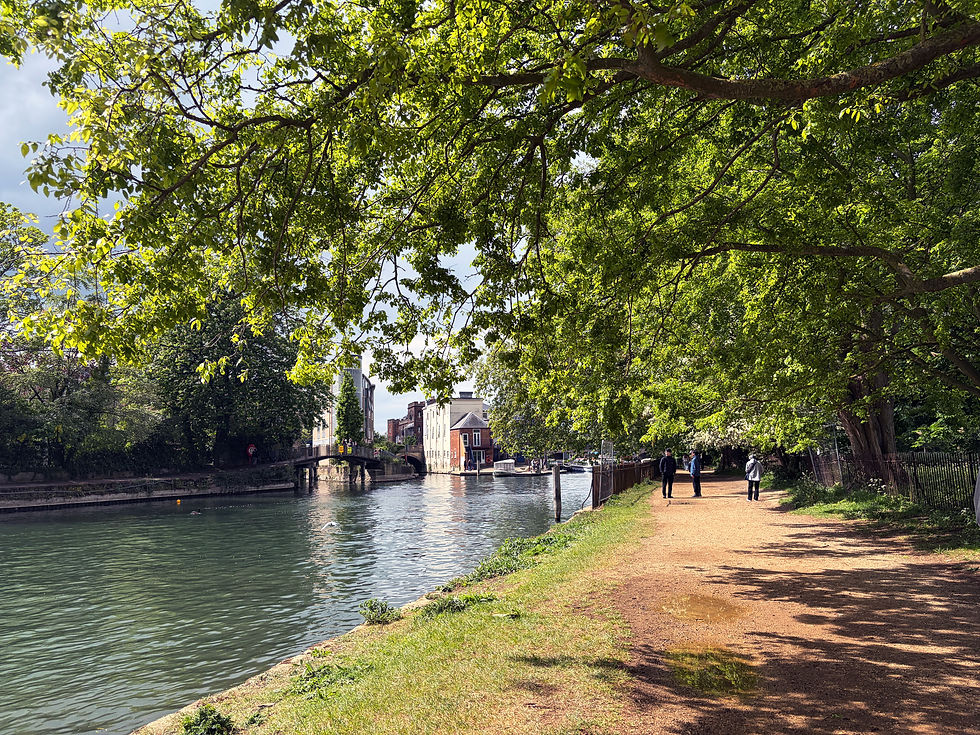
After the session ended at seven, a few of us headed out for pizza by the river, surrounded by greenery. It was a nice way to finish the first day back together before we split up, with some heading off to watch the World Cup while the rest of us called it a night.
Tuesday, July 7, 2026

We began our Innovation module with Megan Morys-Carter and Yasser Bhatti. If I'm honest, I wasn't especially excited going in. Working in healthcare, I've often felt that people love the idea of innovation, but changing a system is something else entirely. My question wasn't so much how do we innovate? It was, how do you implement change in a system that already feels stretched to its limits?
The first thing I learned was that innovation isn't simply inventing something new. It's about successfully implementing ideas that create value. The lecturers reminded us that technology is rarely the hardest part. The real challenge is people, organisations, culture, funding, and all the invisible pieces that determine whether a good idea survives beyond the drawing board.
Later in the morning, several classmates presented innovations they have been leading in their own work. Although we'd already gotten to know one another over meals and coffee breaks, it was another thing entirely to hear about the remarkable initiatives they have led around the world. It made me appreciate just how much experience everyone had brought to Oxford.
Lunch was another feast, with bright salads, lamb tagine, roasted aubergine, couscous, soy and sesame salmon, red cabbage coleslaw, and rice. Downstairs in the clubhouse, they served a rich iced caramel coffee, which was especially welcome on a hot summer afternoon.
The afternoon focused on innovation in low-resource settings. We talked about frugal innovation, not creating cheap products, but designing solutions that deliver the greatest value with the fewest resources.
One example immediately caught my attention. A plastic water bottle could be turned into an asthma spacer. As an allergist, I often see patients who don't use their spacers consistently. They're bulky, not always convenient to carry around, and some people feel self-conscious using them in public. I thought it was cool that something most people would simply throw away could improve medication delivery.
I regretted not bringing my Glia stethoscope, which I ordered after our pre-course readings on frugal innovation. Glia is a Canadian company that developed an open-source, 3D-printed stethoscope for low-resource settings. It's not perfect. I replaced the earpieces because they did not fit. My Littmann and Welch Allyn are more sensitive, but the Glia costs a fraction of the price.
Perhaps the biggest shift in my thinking came when we discussed where innovation comes from. I think many of us instinctively assume that innovation flows from wealthy countries to poorer ones. Instead, we explored examples where solutions developed under severe resource constraints eventually found their way back into high-income health systems. Rather than simply receiving innovation, low-resource settings can become its birthplace.
The final lecture looked at innovation in high-resource settings. Even there, the message was surprisingly similar. The technology itself wasn't the most important part. Success depended on understanding patients, clinicians, and the healthcare system just as much as engineering.
The day ended with a networking reception, where I immediately bumped into Sachi and her friend Sunny, a medical illustrator. It was funny that, in Oxford of all places, we found ourselves as three Chinese Canadians from Toronto, swapping stories about our journeys in medicine and art.
Wednesday, July 8, 2026
I left my accommodation just after 5:30 a.m. to make our rowing session. On the way, I bumped into Abdulkareem, and then Sami cycled past on a rented Lime bike. It felt strange chatting with classmates before 6 a.m.
We arrived to find a generous breakfast spread of bagels, crumpets, pancakes, yoghurt, cream cheese, fruit and coffee with oat milk. There was even a small bowl of sea salt on the table, presumably to replace electrolytes.
After watching the first group head out onto the river, it was our turn. We started on the rowing machines, learning how to row in sync before heading down to the water. We were each assigned a seat and a side of the boat before setting off. I could hear the cox calling instructions, but the terms were unfamiliar. Keeping my stroke in time with everyone else also turned out to be harder than it looked. Later, we debriefed about the rowing experience and what it takes for a group of people with different roles to move together towards the same goal.

Next, we worked through an exercise on ideation, development and selection of ideas. Working with Ben from Kenya and Mareli from Namibia, we looked at improving the diagnostic pathway for lung cancer in Kenya. Rather than jumping straight to solutions, we first defined what "better" meant and mapped a patient's journey through the healthcare system. Members from different groups then exchanged places to share ideas. Some fitted our context well, while others didn't. I realised afterwards that the groups had been organised geographically. Suddenly the exercise made much more sense.
In the afternoon we heard from Dr JD Polk, former Chief Medical Officer at NASA. Although many of his examples came from the space programme, they translated into healthcare. He spoke about innovation not as something optional, but as something necessary, supported by a culture of collaboration where everyone contributes to the mission. One story I particularly liked was about a NASA janitor who, when asked what he did, replied, "I help put people on the moon." Every role mattered because every role contributed to the same goal.
We completely lost track of time and soon it was the afternoon break. Sunny, who was auditing the lecture, had spent the session illustrating the ideas as JD Polk spoke. It was fascinating to see the lecture interpreted visually rather than captured as pages of written notes.

Illustration by Sunny Yimeng Dong
His second session focused on learning from failure. Rather than blaming individuals, he argued that organisations need psychological safety, so people feel able to question decisions, raise concerns and learn from mistakes before they become disasters.
Thursday, July 9, 2026
Walking to class that morning was difficult. It was as if my legs didn't want to move. I wondered whether it was the rowing from the day before, or the jet lag. I stopped by the clubhouse for an iced oat coffee, but it felt like the kind of tiredness that no amount of caffeine could fix.
Then I realised what it was. Another heatwave had arrived. None of our accommodation had air conditioning, and I don't think any of us had slept very well. We all seemed to be wilting together.
Despite the heat, some of the most thought-provoking lectures of the week took place that day. Rather than asking how to generate new ideas, the discussions focused on a different question: why do so many good ideas never spread?
One lecture centred on a low-cost surgical mesh made from mosquito net material. Although it is manufactured and sterilised in the UK using the same polypropylene as commercial surgical mesh, it can only be used in lower-income countries despite studies showing comparable clinical outcomes. Alvena pointed out that even the name "mosquito-net mesh" creates a perception problem. Describing it instead as "low-cost mesh" immediately changes how people think about it.
That simple observation led to a much bigger discussion. If the evidence shows similar outcomes, why is it considered acceptable for patients in lower-income countries but not in wealthier ones? Why do we instinctively trust one product more than another when the science suggests they perform equally well?
Matt Harris then expanded that idea beyond a single product. He described how it took eighteen years before the NHS adopted a community health worker model inspired by Brazil despite strong evidence that it worked. The delay wasn't because the evidence was lacking, but because people struggled to accept an idea that came from somewhere they did not usually associate with healthcare innovation. He also pointed out that much of the research we read, cite and teach comes from Western countries, particularly the United States. It made me wonder how many valuable ideas and experiences we overlook simply because they originate elsewhere.
By the end of the day, however, it had also become clear that evidence and perception are only part of the story. Even a technically sound innovation may never reach patients if the surrounding system cannot support it. Regulation, intellectual property, commercial viability and sustainable business models all determine whether a good idea ever becomes routine practice.

After class, I went to Brasenose College to meet Faojia from the Oxford Global Health Society. We caught up in the graduate common room while she told me more about the Society's activities, including plans for a future trip to Geneva. Afterwards, we walked towards Radcliffe Camera and the Bridge of Sighs.

I met up with the rest of my cohort at Balliol College for the formal dinner. It was either cultural dress or black tie, so I wore a Chinese cheongsam. Despite the heat, none of the men were willing to remove their jackets or bow ties. There was only one fan in the dining hall. At one point, someone quietly turned it towards our table, much to our relief and to the obvious disapproval of the neighbouring table.
Friday, July 10, 2026
We began the morning with our innovation pitches, the formative assessment for this module. Each of us had four minutes to convince a fictional decision-making body to support our innovation. It was a chance to bring together many of the ideas we had explored throughout the week.
It was fascinating to see everyone switch back into their professional roles. We’d come to know one another as friends and classmates. During the presentations, we saw one another as healthcare leaders.
Later that morning, we had a session on artificial intelligence. One idea caught my attention. It is easy to become a consumer of AI, or even a critic of it, but much harder to become a co-creator. Rather than asking what AI can do today, we were encouraged to imagine what healthcare might look like in the future and then work backwards to think about what would need to exist to make that future possible.
The rest of the afternoon looked ahead to the next phase of the programme before we said our goodbyes ahead of flights home.
Before dinner, I spent some time in a £5 bookshop while waiting to meet everyone. The basement was noticeably cooler than outside, making it a good place to wait.
That evening, a few of us met for Lebanese food. Even though it was already late in the evening, it was still hot enough that finding a restaurant with air conditioning had become one of the deciding factors. Afterwards, we headed home.
Saturday, July 11, 2026
Even though it was only around eleven in the morning, it already felt much later. The sun had risen so early, and by then it was already bright and hot enough that it felt as though half the day had gone by.
Bell, Hashem and I had planned to meet at a café but instead discovered the Oxford Outdoor Market nearbby. With so many international food stalls to choose from, changing our plans wasn't difficult. I chose a potato and spinach curry with vegetarian Hakka noodles.
After lunch, we walked Bell to the bus station before Hashem and I looked for a few gifts for his family back home.
By then, it was getting quite hot. I headed over to Saïd Business School, partly because I knew it had air conditioning. Even there, it still felt warm. I bumped into Sachi again, who was helping to run a multi-day event. She looked busy making sure participants had enough water.
As a part-time student, my visits to Oxford are usually scheduled from morning until evening before it's time to head home again. That afternoon, I stayed in the clubhouse for a while, watching people come and go. It was nice simply to have nowhere else I needed to be.
Looking back
As a clinician working across different healthcare settings, this week reminded me that even identifying the right problem takes time. Context matters.
I also came away thinking differently about innovation. It isn't always a new technology or the most expensive. Sometimes it's frugal.
Perhaps the biggest lesson for me was that good ideas don't always come from the loudest voices or the best-resourced environments. As healthcare leaders, one of our responsibilities may simply be to recognise those ideas, give them a chance to be heard, and help them reach the people who need them.


Comments